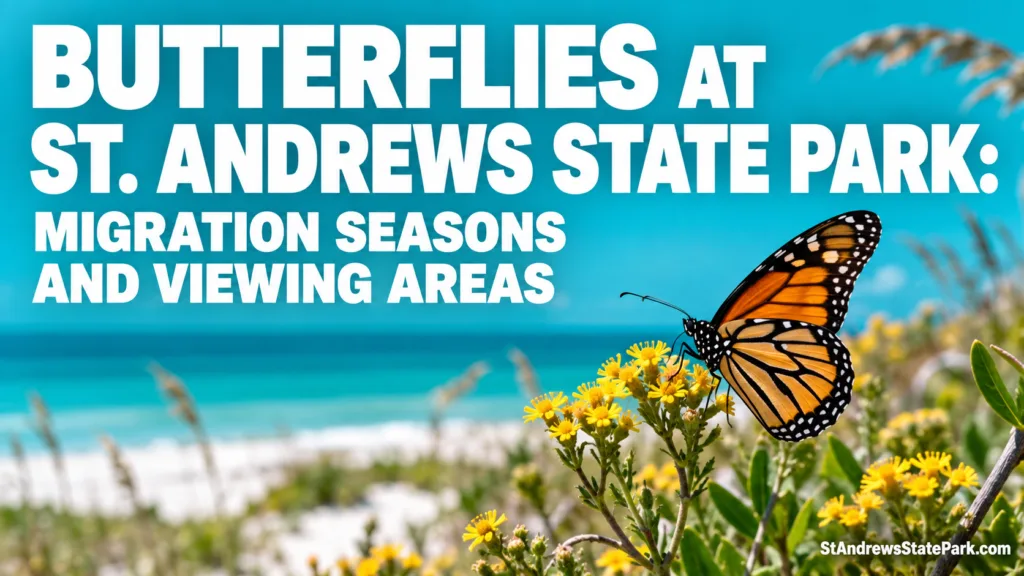
St. Andrews State Park sits on a narrow stretch of Florida’s Gulf Coast where open shoreline, scrub, marsh, maritime hammock and pine habitat meet within a relatively small area. That mix matters to butterflies. Florida State Parks describes St. Andrews as a migratory stopover for numerous bird and butterfly species, while the park’s management plan documents native nectar and host plants that can support butterflies moving through or breeding locally.[a] Fall is the most interesting season for visible migration, but butterflies can be found here during much more of the year.
For migration-focused viewing: September through October deserves the most attention, with October usually offering the strongest regional monarch signal along the Florida Panhandle coast. Exact dates shift from year to year because butterfly movement responds to temperature, wind, cold fronts and the availability of blooming nectar plants.
Butterfly Seasons at St. Andrews
There is no fixed annual “butterfly week” at St. Andrews. Migration comes in pulses. A quiet morning may be followed a few days later by repeated southbound sulphurs or a noticeable rise in monarchs after favorable weather. Resident butterflies and migratory butterflies also overlap, so seeing a monarch, Gulf fritillary or cloudless sulphur does not automatically prove that the individual is actively migrating.
| Season | What to Expect | Most Useful Areas |
|---|---|---|
| March–May | Northward dispersal, spring emergence and growing butterfly diversity as flowers become available. | Sunny trail margins, flatwoods edges, Gator Lake and Heron Pond areas. |
| June–August | Active local populations plus species that have expanded north during the warm season. Gulf fritillaries, sulphurs, skippers and buckeyes may be active. | Flowering trail edges, Buttonbush Marsh area and sunny openings. |
| September–October | Strongest migration-oriented period. Southbound monarchs, cloudless sulphurs, Gulf fritillaries and other seasonal movers may pass through Northwest Florida. | Sheltered coastal vegetation, flowering uplands, trail margins and marsh-edge nectar plants. |
| November–February | Activity becomes more dependent on individual warm, sunny days. Cold periods in the Panhandle can sharply reduce visible flight. | Sunny, wind-protected openings and south-facing vegetation edges. |
The regional pattern is especially clear in fall. At nearby St. Marks National Wildlife Refuge on Florida’s Gulf Coast, the U.S. Fish and Wildlife Service lists September as a month when sulphurs, swallowtails and skippers feed heavily along roadsides, followed by the arrival of migratory monarchs in October. By November, colder weather usually reduces butterfly activity.[b] St. Andrews is farther west, so this should be treated as a Panhandle timing reference rather than a guaranteed calendar for a particular day at the park.
Fall Migration Is the Main Event
Late summer begins a broad southward movement across the eastern United States. For monarchs, the migratory generation can travel from northern breeding areas toward Mexico. The U.S. Fish and Wildlife Service reports that eastern monarchs may travel up to about 3,000 miles, while tagging observations suggest roughly 70–75 miles can be covered in a day under suitable conditions.[c]
Coastal Northwest Florida has a special role because butterflies reaching the Gulf encounter a geographic boundary. Some continue westward, some move along the coast, and some stop to feed. On favorable fall days, the movement can become much easier to notice. Watch direction as well as numbers. A succession of butterflies crossing the same opening in a similar direction tells you more about migration than a single individual circling a patch of flowers.
Weather can matter more than the date. Butterflies need solar warmth for flight. UF/IFAS notes that late morning and early afternoon on sunny days generally produce high activity. Light wind also makes butterflies easier to follow and allows them to feed instead of constantly fighting coastal gusts.[d]
Migratory Butterflies to Watch For
St. Andrews does not publish a complete, day-by-day butterfly inventory, so it is better to separate species that are realistic regional targets from species guaranteed to appear on a particular visit. Several well-known Florida migrants fit the park’s habitats, and the approved management plan records host or nectar plants associated with some of them.[e]
| Butterfly | Adult Size | Seasonal Clue | Identification |
|---|---|---|---|
| Monarch Danaus plexippus | 85–120 mm wingspan | Fall migration is the main coastal event. | Orange wings, heavy black veins and black margins with white spots. |
| Cloudless Sulphur Phoebis sennae | 50–68 mm | Large southbound movements occur in fall. | Large, fast-flying yellow butterfly; females may appear paler. |
| Gulf Fritillary Agraulis vanillae | 50–74 mm | Moves north in spring and south in large numbers from late summer into fall. | Orange upper wings; elongated silver spots shine on the underside. |
| Long-tailed Skipper Urbanus proteus | 48–58 mm | Expands north during the warm season and moves south again in fall. | Brown wings, long hindwing tails and blue-green iridescence near the body. |
Monarch
The monarch is the butterfly most visitors associate with migration, but Florida makes its story more complicated. Some monarchs are long-distance migrants while other populations remain in warmer parts of Florida. Northern Florida experiences colder winters than South Florida, making the autumn movement especially relevant along the Panhandle.
During fall migration, monarchs may travel high enough to escape casual notice. Then conditions change and they descend to feed. This is why a coastal patch of blooming goldenrod, thoroughwort or other nectar-producing flowers can suddenly become more interesting than an open stretch of beach. The park management plan records several goldenrods, including seaside goldenrod, sweet goldenrod and Chapman’s goldenrod, as well as pinewoods milkweed (Asclepias humistrata). That combination gives the park both nectar resources and a native monarch host plant.
Cloudless Sulphur
A large yellow butterfly repeatedly moving in one direction deserves a second look. UF/IFAS describes the fall migration of cloudless sulphurs as one of the easiest butterfly migrations to observe in the southeastern United States. Their directional movement can be far more obvious at eye level than monarch migration, since monarchs sometimes travel high above the ground.[f]
The botanical connection at St. Andrews is worth noticing. The park plan records partridge pea (Chamaecrista fasciculata), sensitive pea and sicklepod, plants within the group used by cloudless sulphur caterpillars. Adult sulphurs range much more widely while looking for nectar, so sunny openings between plant communities are often more useful for observation than trying to locate one specific host plant.
Gulf Fritillary
Gulf fritillaries fit the coastal setting particularly well. UF/IFAS records the species throughout Florida and describes a seasonal cycle in which adults move northward in spring, then migrate south from late summer through fall.[g] Their silver-spotted underwings make them unusually easy to recognize when they pause with their wings partly closed.
St. Andrews’ plant list includes purple passionflower or maypop (Passiflora incarnata), a larval host of the Gulf fritillary. That does not mean every maypop vine will hold eggs or caterpillars, yet it adds a useful biological reason to examine sunny vegetated margins rather than concentrating only on the shoreline.
Long-tailed Skipper and Other Seasonal Movers
The long-tailed skipper adds another migration pattern. Florida Museum information describes adults dispersing northward each year and then moving south into peninsular Florida in fall. Its host plants include butterfly pea and ticktrefoils; St. Andrews’ management plan records spurred butterfly pea along with several ticktrefoils.[h]
Common buckeyes, American ladies, swallowtails and other butterflies may also occur in the same sunny habitats. Not all of them will be engaged in long-distance migration. That distinction matters: a butterfly-rich day and a migration day are not necessarily the same thing.
Best Butterfly Viewing Areas
The open Gulf beach is visually dominant at St. Andrews, but the most productive butterfly habitat usually sits just inland. Butterflies need nectar, host plants, sunlight and places protected from wind. Trail edges and transitions between habitat types provide those features more consistently than bare sand.
Gator Lake Trail
The approved park plan lists the Gator Lake Trail at about 0.6 mile. Its value for butterfly watching comes from the changing light and vegetation around the freshwater and upland edge. Look across sunny openings and flowering vegetation before immediately walking onward. Butterflies often cross a trail repeatedly while moving between nectar sources.
On cooler mornings, sunlit patches can be especially useful because butterflies use solar warmth to raise their flight temperature. On breezier days, check vegetation on the sheltered side of the trail rather than exposed openings.
Heron Pond Trail
The same management plan lists Heron Pond Trail at about 1 mile. A longer vegetated route gives more chances to pass through subtle habitat transitions where skippers, sulphurs, fritillaries and buckeyes may feed or bask. Watch the edge of the trail rather than only the center of the path. Small butterflies can disappear into low vegetation the instant they land.
Buttonbush Marsh Overlook
Buttonbush Marsh is one of the park’s most distinctive inland areas. The management plan describes common buttonbush (Cephalanthus occidentalis) around portions of the marsh perimeter. UF/IFAS lists buttonbush as a native Florida nectar plant used by butterflies.[i]
That makes the overlook and its accessible approach worth checking when shrubs are flowering. The goal is not to enter the wetland. Remain at the designated viewing area and paths, then scan flower heads and nearby sunny vegetation. A butterfly feeding on buttonbush may remain in one area long enough for careful observation.
Maritime Hammock and Sheltered Edges
The park plan describes maritime hammock as a dense coastal woodland of live oak, sand live oak, red bay, cabbage palm, yaupon and other salt-tolerant vegetation. The interior may be shaded, but sunlit hammock edges can offer a useful combination of warmth and wind protection. On a breezy Gulf day, such sheltered margins may produce more close butterfly views than exposed coastal areas.
Coastal Scrub and Dune Edges
St. Andrews contains extensive scrub and beach-dune habitat. The park plan also records flowering plants such as goldenrods, gayfeathers, false foxgloves, thoroughworts and yellow buttons. These plant communities can support nectar-seeking insects through different parts of the warm season.
There is an important boundary here: observe from designated trails, boardwalks and access points. The management plan notes that unauthorized paths can damage coastal scrub and increase fragmentation and erosion. Staying on established access routes protects the same vegetation that makes these areas valuable to wildlife.
Where Migration Is Easier to Notice
| Area Type | Butterfly Value | What to Watch |
|---|---|---|
| Sunny trail edge | High | Feeding, basking and repeated directional crossings. |
| Flowering marsh edge | High when blooms are present | Nectar feeding, especially around buttonbush and other flowers. |
| Sheltered hammock edge | Useful in wind | Resting and feeding butterflies protected from Gulf breezes. |
| Designated scrub or dune edge | Seasonally useful | Fritillaries, sulphurs, buckeyes and passing migrants around flowers. |
| Open beach | More useful for movement than feeding | Butterflies crossing the shoreline or moving along the coast rather than lingering. |
Time of Day Makes a Difference
Butterfly watching does not require a dawn start. Most butterflies depend on sunlight to warm their flight muscles, so late morning through early afternoon often produces more visible activity than the first hour after sunrise. UF/IFAS specifically recommends sunny late-morning and early-afternoon periods for general butterfly observation.
A cool but bright morning can still be interesting. Butterflies may sit with their wings positioned toward the sun before becoming fully active. Once warmed, they begin moving between flowers and habitat patches. Warmth wakes the landscape up quickly.
- Sunny conditions: usually improve flight and feeding activity.
- Light wind: makes butterflies easier to locate and follow.
- Flowering vegetation: can concentrate adults that would otherwise pass unnoticed.
- A recent cool front in fall: can change migration movement and wind direction, so one day may differ sharply from the next.
- Cold or heavily overcast periods: usually reduce visible flight even when butterflies remain in the area.
Host Plants Explain Part of the Park’s Butterfly Value
Adult butterflies can travel far beyond the plants used by their caterpillars, yet host plants help explain why certain habitats repeatedly support particular species. St. Andrews’ documented flora includes several useful examples: pinewoods milkweed for monarchs, maypop for Gulf fritillaries, partridge pea and senna relatives for sulphurs, and butterfly pea and ticktrefoils for long-tailed skippers.
The plan also lists nectar-producing plants such as goldenrods, gayfeathers, buttonbush, thoroughworts and other native flowers. Migration depends on more than a flight corridor. Butterflies also need places to stop and refuel. Along the Gulf Coast, a flowering patch can function much like a small service station for an insect crossing a much larger landscape.
One useful distinction: host plants feed caterpillars; nectar plants feed adult butterflies. A monarch may stop on goldenrod for nectar even though monarch caterpillars cannot live on goldenrod. For larvae, monarchs require milkweed.
Sources
- Florida State Parks — St. Andrews State Park — Confirms the park’s role as a migratory stopover and describes its principal coastal habitats. (Official Florida State Parks source.)
- U.S. Fish & Wildlife Service — St. Marks National Wildlife Refuge: Seasons of Wildlife — Provides regional Florida Panhandle timing for fall sulphurs, skippers, swallowtails and monarch arrival. (Official federal wildlife agency.)
- U.S. Fish & Wildlife Service — Monarch — Covers migration distance, movement and biology of the eastern North American monarch population. (Official federal wildlife agency.)
- University of Florida IFAS — Spotting and Identifying Butterflies — Supports butterfly activity timing, habitat use and observation conditions. (University extension source.)
- Florida Department of Environmental Protection — St. Andrews State Park Approved Unit Management Plan — Documents the park’s natural communities, trails and recorded plant species, including butterfly host and nectar plants. (Official Florida DEP management document.)
- University of Florida IFAS — Cloudless Sulphur — Describes the species’ fall migration and host plants. (University entomology source.)
- University of Florida IFAS — Gulf Fritillary Butterfly — Documents statewide occurrence and seasonal northward and southward movements. (University entomology source.)
- Florida Museum of Natural History — Long-tailed Skipper — Gives identification, host plants and seasonal migration behavior. (University museum and biodiversity research institution.)
- University of Florida IFAS — Nectar Plants — Identifies buttonbush and other Florida plants used as nectar sources by adult butterflies. (University extension source.)
Frequently Asked Questions
What is the best month to see migrating butterflies at St. Andrews State Park?
October is usually the strongest single month to target for fall migration along the Florida Panhandle coast, especially for monarch activity. September can also be productive for sulphurs, skippers and other migrants. There is no guaranteed peak date because cold fronts, wind and flowering conditions influence movement.
Are monarchs the only butterflies that migrate through Northwest Florida?
No. Cloudless sulphurs, Gulf fritillaries and long-tailed skippers are among the Florida butterflies known for seasonal movement. Common buckeyes and several other species also show seasonal dispersal or migration.
Where should I look for butterflies inside St. Andrews State Park?
Start with sunny vegetated edges around Gator Lake Trail, Heron Pond Trail and the Buttonbush Marsh overlook. Sheltered maritime-hammock margins and designated scrub edges can also be productive. Flowering vegetation is usually more useful for prolonged viewing than open beach sand.
Can butterflies be seen at St. Andrews outside migration season?
Yes. Florida supports butterfly activity through much of the year, and several species have long flight seasons. Spring and summer generally offer broader butterfly diversity, while fall adds the possibility of visible directional migration. Winter sightings depend more heavily on warm, sunny weather.
What time of day is best for butterfly watching?
Late morning through early afternoon on a sunny day is a reliable window because butterflies use solar warmth to become fully active. Light wind also helps. Cooler mornings may still be productive once butterflies begin basking in direct sun.
Is the beach the best place to see migrating butterflies?
The beach can reveal butterflies moving along or across the coast, but flowering trail edges, marsh margins and sheltered vegetation usually provide better opportunities for close observation. Migrants need nectar and protection from strong wind, so they often become easier to see once they stop in vegetated habitat.