Gopher tortoises are easy to miss at St. Andrews State Park if your attention stays on the water. Look inland, though, and the landscape changes quickly. Dry sandy ground, pine flatwoods, scrub and old dune ridges provide the kind of habitat used by the gopher tortoise (Gopherus polyphemus). The park’s approved management plan records the species in beach dune, scrub and mesic flatwoods habitat, giving visitors a useful clue about where to concentrate their attention.[a]
🐢 A useful starting point: If seeing a gopher tortoise is one of your priorities, spend more time on the mainland nature trails and their sunny habitat edges than around the busiest waterfront areas. The park plan specifically records gopher tortoise populations on the mainland and describes monitoring of their burrows there.[a]
Where to Look for Gopher Tortoises
A tortoise can wander away from its burrow while feeding, so there is no single guaranteed viewing point. Habitat gives you better odds than a pin on a map. At St. Andrews, the strongest places to watch are where open sunshine, sandy soil and low vegetation occur together.
| Area | Why It Is Worth Watching | What to Look For |
|---|---|---|
| Heron Pond Trail | The official trail description places this half-mile trail in flatwood pine forest, one of the habitat types associated with tortoises at St. Andrews. | Sandy openings, sunny trail edges, low vegetation and half-moon-shaped burrow entrances. |
| Scrub and flatwoods edges | The park plan records gopher tortoises in scrub and mesic flatwoods. | Bare sandy patches, disturbed sand and short feeding paths through vegetation. |
| Gator Lake Trail surroundings | The trail passes views of coastal and scrub forest. Drier scrub portions are more relevant than the wet lakeshore itself. | Watch dry sandy ground beside the designated route rather than the water’s edge. |
| Sunny roadside and trail margins | Open edges can provide sunlight and low-growing plants used for basking and feeding. | A moving shell in grass, a tortoise crossing, or fresh sand at a burrow entrance. |
| Older dune and scrub transitions | Beach dune and scrub are both listed among the park habitats used by the species. | Observe only from established trails, roads or boardwalks. Do not walk into protected dune vegetation. |
Heron Pond Trail Is a Logical Place to Start
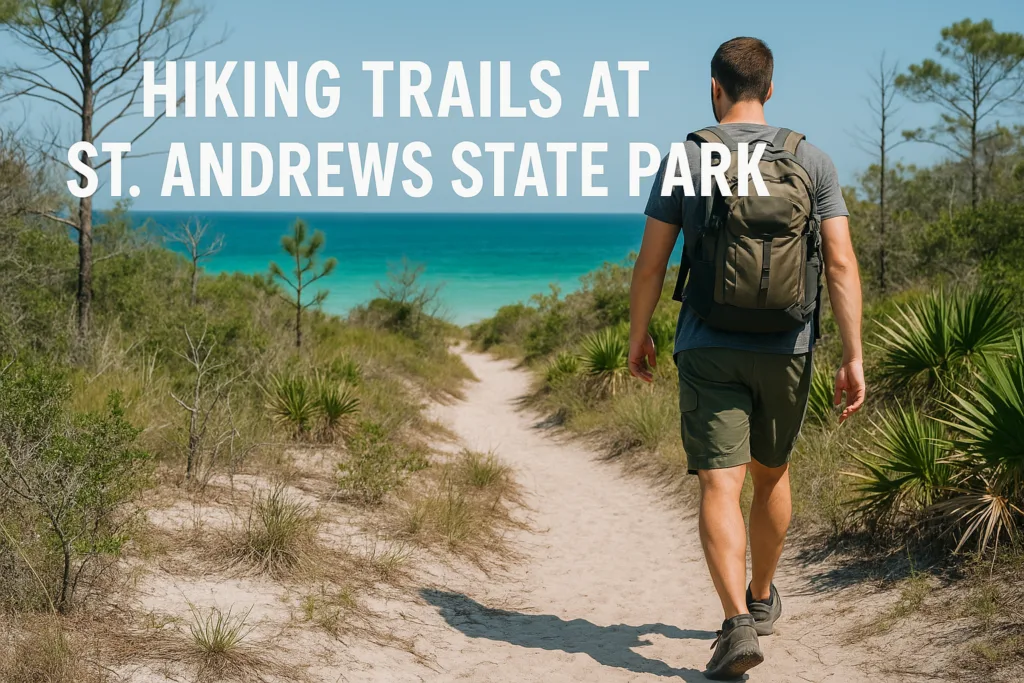
St. Andrews has two official half-mile nature trails. Heron Pond Trail runs through the park’s flatwood pine forest toward Sandy Point, while the Gator Lake Trail follows a different mix of lakeside and coastal habitat.[b]
For a tortoise-focused walk, the Heron Pond route makes sense because the park’s own species inventory associates gopher tortoises with mesic flatwoods. Do not expect one beside every stretch of trail. Instead, slow down when the forest opens and sunlight reaches sandy ground.
Scan several yards ahead rather than staring only at your feet. A tortoise feeding quietly beside vegetation can look surprisingly similar to a gray-brown stump until it moves.
Watch the Dry Side of Gator Lake Trail
Gator Lake itself is wet habitat, which is not what you are searching for. The surrounding route is more varied. Florida State Parks describes the area as including coast and scrub forest, including patches of Florida rosemary scrub.[b]
That distinction matters. A gopher tortoise is a terrestrial tortoise, not one of the aquatic turtles you might see around a lake. Keep your attention on dry, sunny sandy sections away from the water, especially where vegetation becomes lower and more open.
Do Not Overlook Scrub and Old Dune Ridges
The habitat numbers in the park’s management plan help explain why tortoises belong here. The plan mapped about 276 acres of scrub, 234 acres of mesic flatwoods and 161 acres of beach dune within St. Andrews State Park.[a] Those figures describe habitat rather than tortoise population size, but they show that the park contains plenty of the dry coastal landscape associated with the species.
Some of the park’s scrub grows on dry sandy ridges formed from older dunes. That is exactly the sort of ground where watching for burrow signs makes more sense than searching marsh edges or heavily shaded wet areas.
👣 Stay on the designated route. Finding promising habitat is not an invitation to walk into the scrub or across dunes. St. Andrews manages visitor access through these sensitive communities, and an unseen tortoise burrow can extend well beyond the visible entrance.
Look for the Burrow Before the Tortoise
Most gopher tortoise searching is really burrow searching. Florida wildlife biologists describe a typical active burrow entrance as broadly half-moon shaped, with excavated sand spread in front of the opening. That patch of loose soil is called the burrow apron. Entrance width can range from roughly 2.5 to 15 inches, depending on the size of the animal that made it.[c]
- Shape: flattened along the bottom and curved across the top, roughly matching a tortoise’s body profile.
- Apron: a fan or mound of excavated sand outside the entrance.
- Fresh activity: loose soil, tracks or a relatively clear entrance may show recent use.
- Setting: well-drained sand with sunshine and nearby low-growing plants is more promising than saturated ground.
Do not put a hand, stick, camera or other object into an opening. Nor should you stand on top of it. The visible hole is only the doorway to a much larger underground structure.
The Underground Part Is Much Larger Than It Looks
FWC reports that gopher tortoise burrows average about 15 feet in length and 6.5 feet deep, while documented burrows can reach about 40 feet long and 10 feet deep.[d] The tortoise may therefore be several yards from the entrance even when the surface appears empty.
That burrow is also why patience works better than approaching closely. Gopher tortoises spend up to 80% of their time underground, where temperature and humidity are more stable.[d] Finding a burrow does not mean the animal will immediately appear.
When You Have the Best Chance of Seeing One Above Ground
Temperature strongly shapes tortoise activity. Florida’s wildlife agency notes that activity is often highest during the mid-morning and mid-afternoon.[e] That makes those periods useful starting windows, although weather matters more than the clock alone.
- On a pleasant warm day, watch open ground where a tortoise can bask or feed.
- During very hot conditions, expect animals to make greater use of their underground refuge.
- Spring through early fall brings plenty of above-ground biological activity, including the breeding season.
- A quiet period after weather conditions become comfortable can be more productive than walking quickly through the park.
FWC places the species’ breeding season from March through October. Females generally lay eggs from May through July, often in sunny sandy locations that can include the burrow apron, and hatchlings commonly emerge from August into November.[d]
☀️ Weather can change the pattern. A tortoise does not follow a sightseeing schedule. Think in terms of comfortable basking and feeding conditions, then watch slowly from the trail rather than trying to approach an occupied burrow.
How to Observe a Tortoise Without Changing Its Behavior
A good wildlife encounter is one where the animal continues doing what it was already doing. If a tortoise stops feeding, pulls its head in, turns sharply away or retreats down its burrow as you approach, you have already learned something useful: give it more room.
- Stop rather than approach. Let the tortoise choose the distance.
- Remain on the trail, road edge, overlook or other designated visitor area.
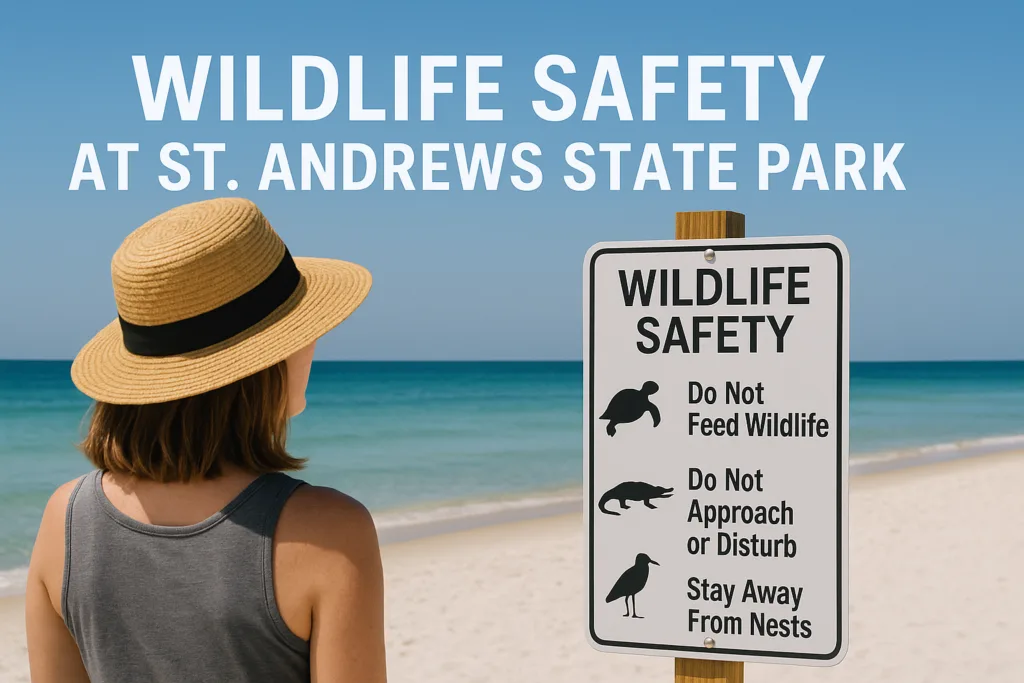
- Keep children and pets from approaching. Pets in permitted park areas should remain under the park’s required leash control.
- Use zoom rather than your feet. A phone camera or binoculars can provide a close view without physically moving closer.
- Never feed the tortoise. Let it select its natural forage.
- Do not touch, pick up or reposition a healthy tortoise.
- Never block, enter or alter a burrow entrance.
Florida lists the gopher tortoise as a state-designated threatened species. State rules prohibit taking, pursuing, harassing or capturing a tortoise and also prohibit molesting, damaging or destroying its burrow unless specifically authorized.[f]
If a Tortoise Is Crossing a Park Road
Sometimes the sighting comes to you. If a tortoise is walking across a park road, slow down, stop when safe and give it time to finish crossing. Do not drive onto a shoulder or vegetation to get around it.
FWC advises leaving healthy tortoises alone when they are not in immediate danger.[g] Inside a state park, a ranger is also an appropriate person to alert if an animal appears injured or is in a situation that requires assistance.
Why the Mainland Deserves Most of Your Search Time
Shell Island has plenty of fascinating coastal habitat, but visitors do not need to make the boat trip specifically to search for a gopher tortoise. The St. Andrews management plan explicitly notes that park managers had recorded gopher tortoise populations on the park mainland and established objectives for monitoring the species.[a]
The same plan called for park-wide burrow surveys at three-year intervals using FWC protocols, along with recording opportunistic sightings of live tortoises and burrows. That is useful context: these animals are not merely an occasional species mentioned on a generic Florida wildlife list. They are part of the park’s documented terrestrial fauna.
Coastal Tortoises Are an Active Research Subject
There is still more to learn about gopher tortoises living along Northwest Florida’s coast. A U.S. Geological Survey project launched in 2025 is studying tortoises using coastal and barrier-island habitats in Northwest Florida, including work at St. Vincent National Wildlife Refuge and other coastal sites in the region.[h]
Researchers are using population surveys, genetics and tracking technology to better understand how coastal tortoises use their habitat. That research is a useful reminder not to picture the species only as an animal of inland longleaf-pine country. Coastal dunes, scrub and sandy flatwoods can also be part of its landscape—exactly the habitat combination found at St. Andrews.
How to Tell a Gopher Tortoise From Other Turtles
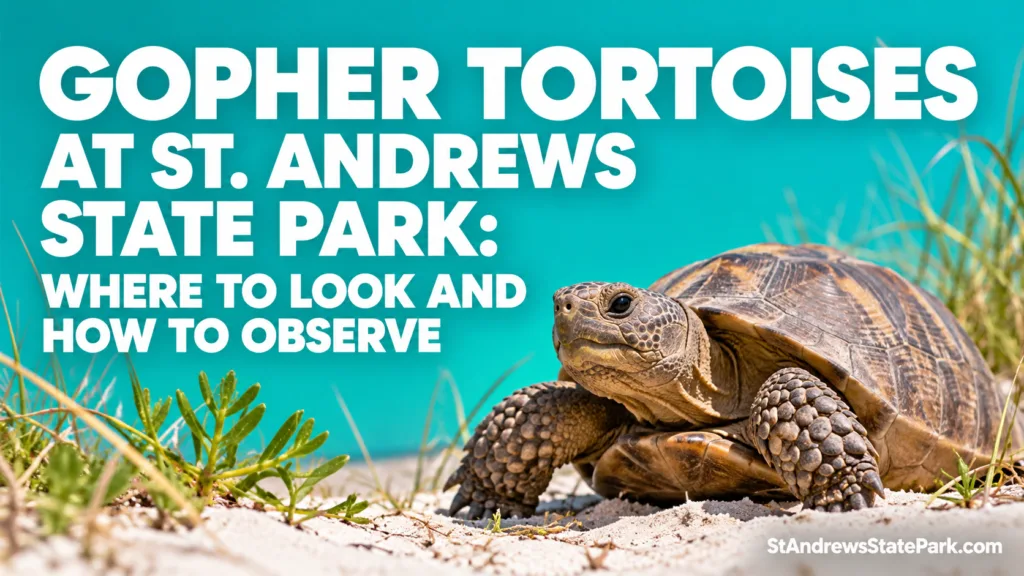
The easiest clue is where you found it. A gopher tortoise walking through dry scrub is built for digging on land, not swimming in Gator Lake. Adults are generally tan, brown or gray, with a high shell and thick, shovel-like front legs. Their hind feet look stout and elephant-like rather than webbed.
FWC reports an adult length averaging about 9 to 11 inches, although individuals can reach roughly 15 inches.[d] Younger tortoises can show brighter yellow-orange and brown coloration that fades as they mature.
The tracks and burrow may tell you even more than shell color. A large half-moon opening in dry sand with a broad apron outside is much more characteristic of a gopher tortoise than of the aquatic turtles visitors encounter around freshwater habitat.
Questions About Gopher Tortoises at St. Andrews
Are gopher tortoises actually found at St. Andrews State Park?
Yes. The official St. Andrews State Park management plan lists Gopherus polyphemus among the park’s documented species and associates it with beach dune, scrub and mesic flatwoods habitat. The plan also records gopher tortoise populations on the park mainland.
Which trail should I try first?
Heron Pond Trail is a sensible first choice for a tortoise-focused walk because it passes through flatwood pine forest, and mesic flatwoods are one of the habitats in which the park records the species. Sightings are never guaranteed.
Can I see gopher tortoises around Gator Lake?
Possibly, but concentrate on dry scrub and sandy ground around the route, not the lake itself. Gopher tortoises are terrestrial. Aquatic turtles around the water are different species.
What does a gopher tortoise burrow look like?
Look for a broad half-moon-shaped entrance in well-drained sandy soil. Excavated sand commonly spreads outside the opening as an apron. An active-looking burrow may also show loose soil or tracks.
Should I wait beside a burrow for a tortoise to emerge?
You can observe from a respectful distance if the burrow is visible from an established visitor area, but do not stand on the apron, approach the opening or block the tortoise’s route. If nothing appears, continue your walk rather than trying to coax the animal outside.
Can I touch a gopher tortoise for a photo?
No. Photograph it where it is and allow it to move naturally. Florida protects both the tortoise and its burrow, and FWC advises leaving healthy wild tortoises alone.
What time of day should I look?
FWC notes that gopher tortoise activity is often highest during mid-morning and mid-afternoon. Temperature and weather still matter, so treat those periods as useful viewing windows rather than fixed times.
Sources
- [a] Florida Department of Environmental Protection — St. Andrews State Park Approved Unit Management Plan. Used for the park’s natural communities, habitat acreage, documented gopher tortoise occurrence and monitoring information. (Official Florida state park planning document.) View the management plan.
- [b] Florida State Parks — St. Andrews State Park Experiences & Amenities. Used for official descriptions of Heron Pond Trail, Gator Lake Trail and visitor access. (Official Florida State Parks website.) View park trail information.
- [c] Florida Fish and Wildlife Conservation Commission — How to Identify a Gopher Tortoise Burrow. Used for burrow entrance shape, apron characteristics and entrance dimensions. (Florida’s state wildlife agency.) View the burrow identification information.
- [d] Florida Fish and Wildlife Conservation Commission — Gopher Tortoise Species Profile. Used for appearance, body size, burrow dimensions, time spent underground, breeding biology and habitat. (Florida’s state wildlife agency.) View the species profile.
- [e] Florida Fish and Wildlife Conservation Commission — How to Help Gopher Tortoises. Used for activity timing and wildlife observation guidance. (Florida’s state wildlife agency.) View FWC guidance.
- [f] Florida Fish and Wildlife Conservation Commission — Gopher Tortoise Rules and Regulations. Used for Florida threatened status and legal protections for tortoises and burrows. (Florida’s state wildlife agency and regulatory authority.) View the rules and regulations.
- [g] Florida Fish and Wildlife Conservation Commission — What Should I Do If I See a Tortoise? Used for current guidance on encounters with healthy wild tortoises. (Florida’s state wildlife agency.) View FWC sighting guidance.
- [h] U.S. Geological Survey — Management of Gopher Tortoise Using Coastal Habitats. Used for the active research on coastal gopher tortoise ecology in Northwest Florida. (Federal science agency.) View the USGS research project.