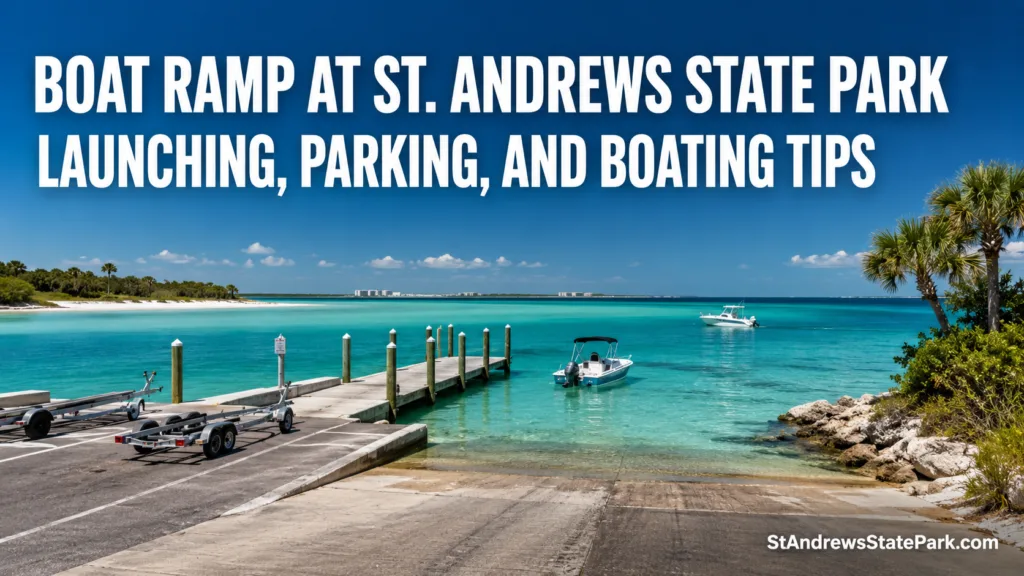
Launching from the boat ramp at St. Andrews State Park puts you directly on Grand Lagoon, with boating access toward St. Andrew Bay, Shell Island and the inlet. The current Florida State Parks listing describes the ramp as a double-sided concrete launch that can accommodate watercraft ranging from small craft to larger boats.[a]
⚓ Launch Type: Double-sided concrete boat ramp on Grand Lagoon, suitable for a wide range of recreational watercraft.
🅿️ Parking Note: Boat and trailer parking is available in the ramp area, but Florida State Parks does not currently publish a live count of standard, oversized or overflow spaces. Follow posted parking signs and current staff directions.
🌅 Timing Note: Normal public hours are 8 a.m. until sundown. Temporary storm, maintenance or operating restrictions can override normal access, so check the current park notice before a boating trip.
Where The Boat Ramp Is Located
The boat ramp is on the Grand Lagoon side of St. Andrews State Park, not on the open Gulf-facing beach. Florida State Parks currently lists a boat ramp and fishing pier on Grand Lagoon, with paddling and boating access from this side of the park.[a]
Inside the park, follow the current signs toward the boat-ramp and lagoon area. A newer restroom is located near the lagoon boat ramp and includes men’s, women’s and family facilities.[e] Picnic facilities and other developed amenities are also available in this part of the park.
| Launch | Double-sided concrete ramp |
| Water Access | Grand Lagoon, St. Andrew Bay, Shell Island and inlet routes |
| Nearby Facilities | Fishing pier, restroom, picnic facilities and concession activity |
| Trailer Parking | Available near the launch; current space counts are not published on the live park page |
| Best For | Boating, fishing, paddling, Shell Island trips and bay cruising |
Launch Fees And Park Hours
Florida State Parks currently lists a combined Boat Launch & Admission fee of $12 for one person with a boat and $16 for two to eight people with a boat.[b]
The park’s normal public hours are 8 a.m. until sundown, 365 days a year. That matters for boaters because retrieval, tie-down and trailer preparation all need to happen before the day-use period ends.
- Arrive early on busy weekends and holiday periods if your day depends on easy trailer movement.
- Check the current fee page before driving to the park because fees can change.
- Plan the return before sundown, allowing extra time to retrieve and secure the boat.
- Bring an accepted payment method: credit and debit cards are accepted, while exact change is required if a cash drop box is being used.
- Check current park status: weather and storm-related conditions can temporarily affect day-use access.
Parking For Vehicles And Boat Trailers
Boat and trailer parking is available around the Grand Lagoon launch area, but the current Florida State Parks visitor pages do not publish a live parking-space inventory. The number and arrangement of usable spaces can also be affected by maintenance, construction, traffic control or other park operations.
An older 2016 park management plan recorded 28 standard paved spaces, 18 oversized paved spaces and an overflow area described as accommodating 50 vehicles with trailers. Those numbers are historical management-plan inventory, not a confirmed 2026 parking count. They should not be used to predict how many trailer spaces will be available when you arrive.[g]
🚗 Current parking configuration should be confirmed from posted signage. Stage coolers, rods, life jackets, dock lines and other gear before entering an active ramp lane, then follow the marked trailer-parking arrangement in use that day.
How To Use The Parking Area Smoothly
- Follow signs designating ordinary vehicle and trailer parking rather than relying on an old parking diagram.
- Complete most boat preparation before occupying the launch lane.
- Do not block vehicle circulation while securing the boat after retrieval.
- Use overflow or alternate parking only where current signs or park staff direct you.
- Keep active ramp approaches clear for vehicles that are launching or retrieving.
What The Launch Area Includes
The current park page confirms a boat ramp and fishing pier on Grand Lagoon. Picnic facilities with tables and grills are listed among the park’s accessible amenities, and the completed restroom near the lagoon boat ramp gives boaters and waiting passengers a current restroom option.[a][e]
Older planning documents give exact dimensions and historical facility counts for this use area, but those figures are better treated as background rather than current operating specifications. For a boating visit, the live park pages and posted signs are the better source for what is available that day.
For Boaters
- Double-sided concrete launch into Grand Lagoon
- Boat and trailer parking nearby
- Access toward St. Andrew Bay
- Private-vessel routes toward Shell Island
- Fishing pier in the Grand Lagoon area
For Waiting Passengers
- Restroom near the lagoon boat ramp
- Men’s, women’s and family restroom facilities
- Picnic facilities elsewhere in the developed lagoon area
- Fishing access close to the launch zone
Boating Routes From The Ramp
Boaters use the ramp for Grand Lagoon, St. Andrew Bay, fishing runs, sightseeing and Shell Island access. Florida State Parks specifically lists boating access to St. Andrews Bay, Shell Island and the inlet from the park.[a]
Grand Lagoon
Grand Lagoon is the immediate waterway outside the launch. It is often more protected than the inlet or open Gulf, but it is still an active boating area with wind, wakes and other traffic to consider.
St. Andrew Bay
From Grand Lagoon, boaters can continue toward St. Andrew Bay. Wider water brings more exposure to wind, wakes and changing conditions, so a calm launch basin should not be used as the only indicator of conditions farther out.
Shell Island
Shell Island is accessible only by boat. Private recreational vessels can reach the island, but landing and anchoring conditions depend on tide, water depth, wind and the type of boat being used.
Ramp Etiquette That Helps Everyone
A busy boat ramp works better when preparation happens before the trailer reaches the water. Put in the drain plug, ready the dock lines, load loose gear and confirm the passenger plan away from the active launch lane.
- Prep away from the ramp. Load coolers, fishing gear and required safety equipment first.
- Have lines ready. Wind and wakes can move a boat while the trailer is being parked.
- Clear the launch after unloading. Move the boat away from the ramp so the next trailer can use it.
- Finish tie-down away from the water. After retrieval, move to an appropriate staging area before securing the boat for travel.
- Keep children clear of active ramp lanes. Reversing trailers, wet pavement and moving boats need room.
- Do not bring pets onto the boat-ramp area. Florida State Parks specifically prohibits pets at boat ramps.[f]
Safety Notes For Grand Lagoon And St. Andrew Bay
Conditions can change between the protected launch area and the wider bay or inlet. Wind, tide, thunderstorms, current and boat wakes all affect a trip. The Florida Fish and Wildlife Conservation Commission publishes current boating-law and safety information for operators.[c]
🛟 Before leaving the ramp: confirm required life jackets and other safety equipment, check fuel, secure loose items and make sure navigation and communication equipment needed for the trip is working. Equipment requirements vary by vessel type and operation, so use current FWC rules rather than a generic packing list.
Check Water And Weather Before Launching
For tide and water-level planning, use current marine forecasts and official tide resources rather than judging conditions only from the boat ramp. NOAA’s Tides & Currents service provides coastal water-level and tide information.[d]
- Check wind and thunderstorms before launching.
- Allow more return time if the route includes exposed bay or inlet water.
- Follow navigation markers, posted speed rules and channel restrictions.
- Do not assume conditions outside the lagoon match the water inside the launch basin.
Kayaks, Paddleboards And Small Craft
Florida State Parks promotes paddling on Grand Lagoon and currently lists kayaks and paddleboards through the park concession operation. A boat-rental shack is located beside the boat ramp, with additional paddleboard service at the jetty Store.[a]
Paddlers should avoid setting up directly in an active trailer lane when another suitable signed access point is available. Small craft take less launch space than a trailered boat, but paddles, life jackets, dry bags and other equipment still need to be organized away from reversing vehicles.
Why The Grand Lagoon Ramp Area Gets Busy
The ramp serves several types of visitors at once. Powerboats, fishing boats, kayaks and other watercraft share the broader area with anglers using the Grand Lagoon fishing pier and visitors using nearby park facilities. That mix can make vehicle circulation around the launch busier than the water itself suggests.
Early arrival can reduce pressure on a boating day, but there is no official guarantee that a particular number of trailer spaces will be available at a specific hour. Parking availability depends on actual use and the configuration in place that day.
Good Launch Days And Busy Times
Light wind, manageable marine conditions and lower visitor traffic make launching easier. Weekday mornings often involve less recreational traffic than peak weekend periods, but weather and seasonal demand can change the pattern.
| Time | What To Consider | Boating Note |
| Early Morning | Cooler air and potentially lighter park traffic | Useful for allowing more time on the water |
| Late Morning | More day-use and boating activity may be present | Allow more time for parking and launching |
| Afternoon | Wind and weather can change | Check return conditions before going farther from the ramp |
| Near Sundown | Day-use closing time approaches | Retrieve with enough time to secure the boat and leave |
What To Bring For A Cleaner Launch
A smooth ramp visit starts before the trailer reaches the water. Pack with both launching and retrieval in mind.
- Dock lines appropriate for the boat and launch setup
- Required life jackets sized for the people aboard
- Anchor and rode if your boating plan requires anchoring
- Sun protection and drinking water
- Dry storage for phones, keys and other electronics
- Trailer straps and tie-down equipment ready for retrieval
- Trash storage for food wrappers, fishing packaging and other waste
Using The Ramp With Shell Island Plans
The Grand Lagoon launch is well positioned for private-boat trips toward Shell Island. Florida State Parks identifies Shell Island as a boating destination from St. Andrews, but the island itself is undeveloped and accessible only by boat.[a]
Choose a landing or anchoring location based on current depth, tide, wind and the limits of your vessel. Do not assume a spot that worked on a previous trip will have the same water depth or exposure on another day.
Small Details Many Visitors Miss
- The ramp is on Grand Lagoon, not on the open Gulf beach.
- The current facility is a double-sided concrete launch.
- A fishing pier is located on Grand Lagoon near the boating area.
- The restroom near the lagoon boat ramp now includes men’s, women’s and family facilities.
- Pets are not permitted at boat ramps.
- The 2016 parking counts are historical planning inventory and should not be treated as the current number of available spaces.
- The current parking arrangement should be followed from posted signs and park-staff directions.
- The park’s day-use hours end at sundown, so late retrieval should not be planned like access to a 24-hour marina.
Boat Ramp FAQ
Does St. Andrews State Park Have A Boat Ramp?
Yes. The park has a double-sided concrete boat ramp on Grand Lagoon. Florida State Parks says the launch can accommodate watercraft ranging from small craft to larger boats.
How Much Does It Cost To Launch A Boat?
Florida State Parks currently lists Boat Launch & Admission at $12 for one person with a boat and $16 for two to eight people with a boat. Check the official fee page before visiting in case rates change.
Is There Parking For Boat Trailers?
Yes, boat and trailer parking is available near the launch. However, the current park pages do not publish a live count of standard, oversized or overflow spaces. Follow the parking layout shown by current signs and park staff.
What About The 28 Standard, 18 Oversized And 50 Overflow Spaces Listed Online?
Those figures come from the park’s 2016 management plan. They are historical inventory numbers and should not be treated as a confirmed 2026 parking configuration.
What Water Does The Ramp Access?
The ramp launches into Grand Lagoon, with boating access toward St. Andrew Bay, Shell Island and the inlet. Conditions can change as you move from the lagoon toward more exposed water.
Can Kayaks And Paddleboards Be Used Around The Ramp Area?
Yes. Florida State Parks promotes paddling on Grand Lagoon and lists kayak and paddleboard rentals through the concession operation. Paddlers should keep clear of active trailer-launch lanes.
Are Dogs Allowed At The Boat Ramp?
No. Florida State Parks prohibits pets at boat ramps. Service animals are treated separately under applicable access rules.
What Time Should I Return To The Ramp?
The park’s normal public hours are 8 a.m. until sundown. Leave enough time to retrieve the boat, secure it on the trailer and exit before day-use closing.
Sources
- [a] Florida State Parks — St. Andrews State Park Experiences & Amenities — current source for the double-sided concrete boat ramp, boat launch fees, boating destinations, Grand Lagoon fishing pier, paddling information and current park amenities. (Official Florida State Parks source.)
- [b] Florida State Parks — St. Andrews State Park Hours & Fees — current source for park hours, boat launch and admission fees, card acceptance and exact-change cash-drop-box information. (Official Florida State Parks source.)
- [c] Florida Fish and Wildlife Conservation Commission — Boating Regulations — current boating-law and safety reference for Florida vessel operators. (Official Florida wildlife and boating agency source.)
- [d] NOAA Tides & Currents — federal source for tide, water-level and coastal-condition planning.
- [e] Florida State Parks — Manager’s Message — current confirmation of the completed restroom at the lagoon boat ramp, including men’s, women’s and family facilities. (Official Florida State Parks update.)
- [f] Florida State Parks — Pet Questions — current statewide rule confirming that ordinary pets are not permitted at boat ramps. (Official Florida State Parks policy source.)
- [g] Florida DEP — St. Andrews State Park Approved Unit Management Plan 2016 — retained only as a historical planning source for the former parking inventory. Its 28 standard, 18 oversized and 50-trailer overflow figures are not presented as current parking capacity.