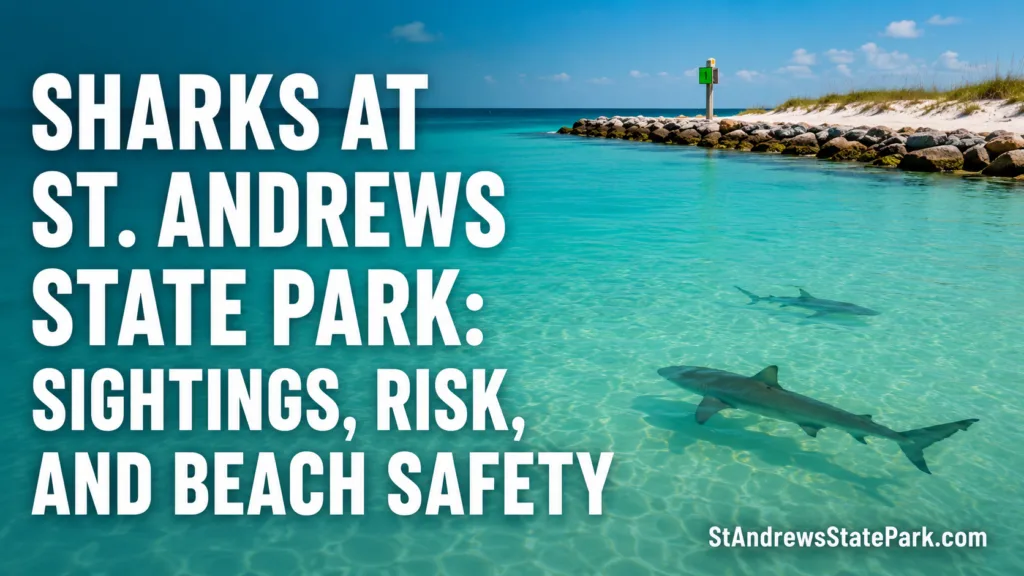
Sharks can pass through the waters around St. Andrews State Park, including the open Gulf shoreline, St. Andrews Pass, the rock jetties and parts of St. Andrew Bay. Seeing one is possible. A bite is far less likely. The practical question is not whether sharks exist here, but where you are swimming, what the water is doing and whether feeding fish are nearby.
The park does not have one uniform swimming environment. The open beach faces moving surf, the pass funnels water between the Gulf and bay, and the pool behind the jetty is calmer but still connected to surrounding marine water. Those differences matter far more than a general claim that the park is either “safe” or “full of sharks.”
🦈 The practical answer: Shark sightings can happen around St. Andrews, especially where baitfish, deeper channels and fishing activity meet. Most visitors enter and leave the water without a shark encounter, but anyone should exit calmly when a shark is confirmed inside a swimming area.
Why Sharks Pass Through These Waters
St. Andrews State Park sits at the meeting point of St. Andrew Bay and the Gulf. Its mainland and Shell Island lands covered 1,167 acres in the park’s approved management plan. The same plan recorded about 13 miles of combined shoreline along the Gulf, bay and Grand Lagoon, including roughly 4.6 miles of Gulf beach. Shell Island contains about three quarters of that Gulf-facing beach.[a]
This arrangement creates several connected water habitats within a relatively small area. Tides move through St. Andrews Pass, small fish gather around structure, and larger animals follow food rather than park boundaries. A shark moving through the pass may simply be traveling between offshore and bay waters.
The Open Gulf Beach
The Gulf side has surf, sandbars and channels that change with waves and weather. Small coastal sharks may follow baitfish into shallow water, sometimes inside the outer sandbar. That can put a fin surprisingly close to shore without the animal showing any interest in swimmers.
Visibility also changes quickly. Clear emerald water can become cloudy after rough surf, wind or a passing storm. In murky water, both the swimmer and the animal have less visual information. More uncertainty, not automatically more sharks.
St. Andrews Pass
The pass acts like a moving doorway between the bay and Gulf. Water, baitfish, sport fish, boats and marine animals can all move through the same corridor. The deeper channel and changing current make this area different from ordinary shallow beach water.
A shark seen crossing the pass should not be described as circling a swimming beach unless its movement actually supports that claim. Direction matters. So does distance.
The Rock Jetties
The jetties were built to protect the navigation channel, but the submerged rocks now function as an artificial reef. Florida State Parks lists rays, redfish, sheepshead, angelfish, octopus, coral and sponges among the marine life found around the structure. Dolphins also feed in the area.[b]
That diversity explains why the jetties attract snorkelers, divers and anglers. It also explains why an occasional shark would not be out of place. Predators visit places where food gathers.
Grand Lagoon and Bay Water
Grand Lagoon is calmer than the open Gulf, but calm water should not be confused with sealed water. The lagoon connects with the bay system and supports fish, rays and other coastal animals. Sharks capable of using bays and estuaries may enter these waters, even when waves are absent.
How Each Part of the Park Changes the Risk
| Water Area | What Shapes Shark Activity | What Swimmers Should Notice |
|---|---|---|
| Open Gulf Beach | Surf, sandbars, baitfish and changing visibility | Fish jumping, birds diving, fins moving along the surf line |
| Protected Jetty Pool | Calmer water connected to the pass and surrounding Gulf | Large animals entering the pool, fishing close to swimmers |
| Rock Jetties | Reef habitat, deeper edges, hooked fish and dense marine life | Active fishing, struggling fish, poor visibility near rocks |
| St. Andrews Pass | Tidal flow, navigation channel, deeper water and boat traffic | Current direction, vessels and animals traveling through |
| Grand Lagoon | Bay-connected water, docks, baitfish and boating activity | Fish feeding at the surface and low visibility near busy areas |
The table is not a ranking from safe to dangerous. Each zone has a different mix of conditions. Near the pass, current and boat traffic may demand attention before a shark ever appears. On the Gulf beach, surf conditions and sandbar channels can shape the immediate swimming risk.
Sightings and Bite Risk Are Different
A shark sighting confirms that an animal was seen, or thought to be seen. It does not show that the shark approached a person, remained in the area or displayed defensive or feeding behavior.
Official bite statistics measure something else. The International Shark Attack File investigated 105 reported shark-human interactions worldwide in 2025 and confirmed 65 unprovoked bites. Florida recorded 11 of the 25 U.S. cases. The county breakdown listed Volusia, Broward, Lee and Miami-Dade counties; it did not list Bay County for that year.[c]
That annual result does not prove that St. Andrews has never had an incident, nor does it predict what will happen on a future beach day. It does show why statewide headlines should not be treated as park-specific evidence.
👁️ A useful distinction: A fin seen near Shell Island, a shark caught by an angler and a confirmed bite inside a designated swimming area are three different records. They should not be combined into one “shark activity” number.
What Makes a Sighting More Reliable?
- The observer identifies the exact park area, not simply “Panama City Beach.”
- The report includes the animal’s direction, distance from shore and length of observation.
- Several people independently see the same animal.
- Park staff, beach safety personnel or another responsible authority confirms the sighting.
- Swimmers are asked to leave a defined section of water.
A short social media clip may leave out all five details. The location could be outside the park, the date could be old, and a dark shape may never be identified.
Sharks Associated With Similar Florida Waters
No short species list can prove which shark produced a distant fin. Still, several Florida species use the kinds of coastal, surf, bay or estuarine environments found around the park. The names below describe possible regional habitat matches, not a promise that each species will be seen during a visit.
Blacktip Sharks
Blacktip sharks occur in Florida coastal waters, bays and estuaries. They are active swimmers, may appear near the surface and can form schools during seasonal movements. FWC lists a maximum length of about six feet, though many animals seen near shore are smaller.[f]
Spinner Sharks
Spinner sharks occur in inshore and offshore waters of the northern Gulf. They feed heavily on schooling fish and may breach while spinning. From shore, they can be difficult to separate from blacktips without a clear look at several fins and body features.[g]
Atlantic Sharpnose Sharks
Atlantic sharpnose sharks use coastal water, the surf zone, bays and estuaries. Adults rarely grow beyond about 3.5 feet. Their diet includes baitfish, jacks, silversides, crabs and shrimp, which helps explain why small sharks may follow food close to shore.[h]
Bull Sharks
Bull sharks can use estuarine, nearshore and offshore water on Florida’s Gulf and Atlantic coasts. Their tolerance for different salinity levels allows them to enter bays, lagoons and river systems.[i] A stocky silhouette in cloudy water is not enough for a certain identification, though.
Distance erases detail. Even experienced observers can confuse similar species when only a dorsal fin appears for a few seconds.
When an Encounter Becomes More Likely
Baitfish Gather Near Shore
Small fish sometimes form a dark or flashing band in the water. They may jump together when chased. Pelicans, terns and other birds can begin diving into the same patch.
Diving birds do not prove that a shark is present, but they do reveal a feeding zone. Swimming through the center of that activity adds no benefit. Move along the beach or wait for the school to pass.
People Are Fishing Beside the Swimming Area
The jetties and park shoreline support surf, pier and jetty fishing. A hooked fish creates vibration and irregular movement. Bait, discarded fish material and struggling catches may also attract larger predators.
FWC advises swimmers to avoid water used for fishing, especially where baitfish or active feeding can be seen. It also recommends staying in a group, remaining near shore, avoiding twilight and using extra care in murky water.[d]
Visibility Drops
Cloudy water makes identification difficult and reduces the time available to react. Sand stirred by surf can hide drop-offs, rays, fish and other swimmers as easily as it hides a shark.
After rough weather, the water may look manageable from a parking area while conditions at the shoreline tell a different story. Check the actual entry point.
A Swimmer Moves Beyond the Group
Swimming alone or far outside the main beach group increases isolation. Help is farther away, and people on shore may not notice a change in behavior. Close to shore and near other swimmers is the more sensible position.
Dawn or Dusk Reduces What You Can See
Low light makes fins, waves and floating debris harder to separate. Some sharks also feed more actively during lower-light periods. The park being open does not mean every open hour offers the same swimming conditions.
Shark or Something Else?
St. Andrews supports enough marine life to produce frequent cases of mistaken identity. A dark shape deserves attention, but not every shape needs a species label.
Dolphins
Dolphins usually roll through the surface in a smooth arc, briefly showing the back and dorsal fin. Several may surface in sequence. Their presence does not prove that sharks are absent; both may follow similar food.
Rays
A ray often appears as a dark diamond or winged shadow moving across sand. In shallow water, the tips of its body may break the surface. From a low viewing angle, that movement can look like more than one fin.
Large Fish
Tarpon and other large fish may roll, splash or expose part of the back. A school fleeing a predator can also create several sharp surface breaks at once.
Waves and Floating Material
A wave crest, dark seaweed or floating debris can repeat the same movement for several seconds. A living animal normally travels with direction and purpose. Still uncertain? Leave the water calmly and look again from shore.
The Protected Pool Is Not Shark-Proof
The shallow pool behind the jetty is popular because the rocks reduce direct wave action. The word protected describes its shelter from surf. It does not mean that a net, wall or sealed barrier separates the pool from marine animals.
Small fish and rays can enter. So can larger animals. The calmer surface may make wildlife easier to notice, but it should not create the impression of a saltwater swimming pool.
🌊 Calmer does not mean closed: The jetty pool can feel easier for families and less confident swimmers, yet adults still need to watch the water, nearby fishing and any instructions from park personnel.
What the Beach Flags Tell You
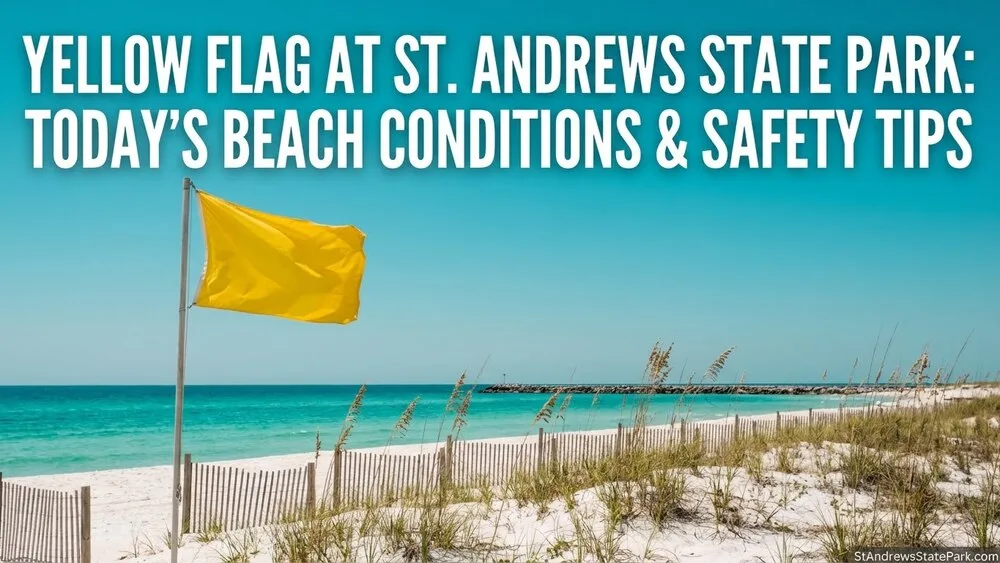
Panama City Beach uses a colored flag system for Gulf conditions. A purple flag means dangerous marine life, but it is not limited to sharks. Jellyfish or another marine animal may trigger the same warning.[e]
| Flag | Official Meaning | What It Means for Shark Questions |
|---|---|---|
| Green | Low hazard; calm conditions with caution still required | Not a declaration that marine animals are absent |
| Yellow | Medium hazard from moderate surf or currents | Water movement may be the immediate concern |
| Red | High hazard from strong surf or currents | Shark interest should not distract from the higher water hazard |
| Double Red | Water closed to the public | Do not enter, regardless of whether a shark was reported |
| Purple | Dangerous marine life | Use care and seek current instructions; it is not shark-specific |
A green flag does not mean “shark-free,” just as a purple flag does not confirm a shark. Read the flag together with posted notices and instructions given at the beach.
What to Do if You See a Shark
When It Is Farther Away
- Keep track of the animal’s direction.
- Tell nearby swimmers in a clear, steady voice.
- Move toward shore without racing through the water.
- Avoid repeated splashing or chasing the animal for a better look.
- Report the location to park or beach safety personnel once ashore.
Do not remain in the water merely because the shark appears small. Size is difficult to judge through moving water, and species identification is rarely certain at a distance.
When It Comes Close
Keep the shark in view, move away smoothly and exit when possible. The Florida Museum advises maintaining eye contact and slowly increasing distance rather than turning the encounter into a burst of uncontrolled movement.[j]
Do not touch it, block its path or attempt an underwater recording. Give the animal open water and take the nearest reasonable route out.
From a Paddleboard or Kayak
- Keep hands and feet out of the water.
- Do not paddle toward the shark.
- Avoid striking the animal with the paddle unless immediate physical protection is needed.
- Move steadily toward shore or another secure location.
- Do not drag bait, caught fish or a fish stringer beside the craft.
Risk by Activity
| Activity | Main Shark-Related Concern | Practical Response |
|---|---|---|
| Shallow Wading | Baitfish or a small shark passing inside a sandbar | Watch the surf line and leave when fish begin fleeing together |
| Swimming | Isolation beyond the main group or reduced visibility | Stay near shore and swim with another person |
| Jetty snorkeling | Dense fish life, deeper edges and nearby anglers | Keep distance from fishing lines and do not snorkel alone |
| Scuba Diving | Longer time underwater and limited surface communication | Use a buddy and agree on exit signals before entering |
| Surf Fishing | Hooked fish can attract sharks close to the line | Keep swimmers away from the active fishing zone |
| Paddleboarding | Travel across feeding areas that are less obvious from shore | Give fish schools and large marine animals a wide path |
| kayaking | Fish or bait hanging beside the craft | Store catches securely and avoid trailing them in the water |
What Parents Should Watch
Children often focus on the water directly in front of them. An adult needs to watch the larger scene: birds gathering, fish jumping, fishing lines entering the swimming zone and people farther down the beach leaving the water.
- Keep young children within immediate reach in the water.
- Check whether anyone is fishing close to the swimming area.
- Do not let children follow dolphins, rays or fish schools into deeper water.
- Explain that the protected pool remains connected to natural marine water.
- Teach one simple response: come to the adult and leave the water calmly.
Shouting “shark” without clear information can create fast, uneven movement in a crowded swimming area. A direct instruction such as “come back to shore now” is easier for a child to follow.
A Simple Water-Entry Decision
Entering the Water Is More Reasonable When
- The water is open and no staff member has ordered swimmers out.
- No shark has been confirmed in the swimming area.
- Baitfish are not clustering or fleeing near shore.
- Fishing activity is separated from swimmers.
- Visibility allows you to watch the surrounding water.
- You can remain near shore and with another person.
Stay Out or Leave the Water When
- A shark is confirmed inside or beside the swimming area.
- Park or beach personnel direct people ashore.
- A double red flag closes the water.
- Fish are jumping repeatedly while birds dive into the same spot.
- Anglers are landing sharks or large fish close to swimmers.
- Cloudy water prevents you from seeing nearby movement.
Someone who feels too uneasy to swim does not need statistical proof to stay ashore. Anxiety can lead to rushed movement and poor decisions. There is no penalty for waiting until the water feels manageable.
Sources and Verification
- Florida Department of Environmental Protection — St. Andrews State Park Approved Unit Management Plan (Park location, acreage, shoreline measurements, pass, jetties and recreation areas; reliable because it is the official state management document.)
- Florida State Parks — Snorkeling at St. Andrews State Park (Jetty construction, artificial reef habitat and marine life; reliable because it is the park system’s official visitor information.)
- International Shark Attack File — 2025 Worldwide Summary (Confirmed bite totals, classifications and Florida county distribution; reliable because ISAF is maintained by the Florida Museum of Natural History and the University of Florida.)
- Florida Fish and Wildlife Conservation Commission — Reducing the Odds of a Shark Bite (Swimming, fishing, visibility and group-safety recommendations; reliable because FWC is Florida’s wildlife authority.)
- City of Panama City Beach — Beach Flags (Official meanings of green, yellow, red, double red and purple flags; reliable because it is the local government’s beach warning page.)
- Florida Fish and Wildlife Conservation Commission — Blacktip Shark (Habitat, behavior and size information; reliable because it is an official FWC species profile.)
- Florida Fish and Wildlife Conservation Commission — Spinner Shark (Northern Gulf distribution, feeding and identification; reliable because it is an official FWC species profile.)
- Florida Fish and Wildlife Conservation Commission — Atlantic Sharpnose Shark (Surf-zone, bay and estuary habitat; reliable because it is an official FWC species profile.)
- Florida Fish and Wildlife Conservation Commission — Bull Shark (Nearshore, estuarine and lagoon habitat; reliable because it is an official FWC species profile.)
- Florida Museum of Natural History — Shark Encounter Safety (Eye contact, controlled retreat and water-exit advice; reliable because the recommendations come from the Florida Program for Shark Research.)
Frequently Asked Questions
Are There Sharks at St. Andrews State Park?
Yes. Sharks are native to Gulf, bay and estuarine waters around Florida. They may pass through the open beach, St. Andrews Pass, the jetties or bay-connected water. Their presence does not mean a bite is likely.
Is the Protected Jetty Pool Shark-Proof?
No. The jetties reduce wave action, but the pool remains connected to natural marine water. Fish, rays and other animals can move into it.
Where Are Sharks Most Likely to Be Seen?
A sighting is more plausible near feeding fish, the deeper edges of the jetties, the navigation pass, surf channels or places where anglers are fighting fish. No section should be treated as a guaranteed shark-viewing location.
Does a Purple Flag Mean a Shark Was Seen?
Not necessarily. Purple indicates dangerous marine life and may apply to sharks, jellyfish or another marine animal. Check current instructions before entering.
Should I Leave the Water if I See a Fin?
Yes, when the fin may belong to a large animal inside the swimming area. Move ashore calmly, avoid excessive splashing and report the location to park or beach personnel.
Are Shark Bites Common at St. Andrews State Park?
Shark bites remain rare compared with the number of people who swim in Florida. Statewide statistics should not be presented as park-specific records, and a sighting should not be counted as a bite incident.