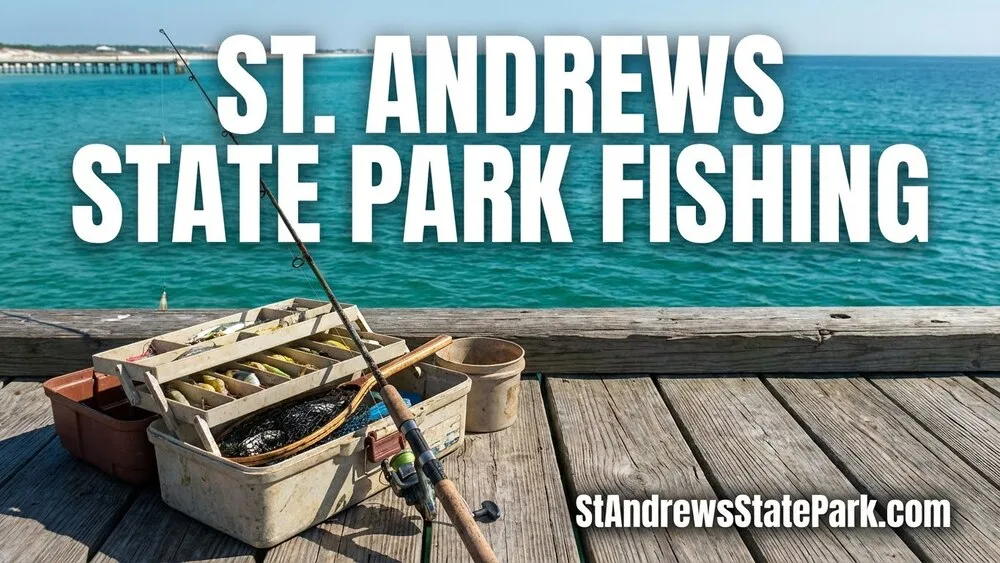
Planning to fish at St. Andrews State Park? The park gives anglers access to several very different types of saltwater: the rock jetties at the pass, Grand Lagoon, fishing piers and the open Gulf beach. That mix is why the species and tackle that work well can change within a short distance. Florida State Parks specifically lists jetty, pier and surf fishing here, with catches that include Spanish mackerel, redfish, flounder, sea trout, bonito, cobia and bluefish.[a]
Where To Fish
St. Andrews gives you three main fishing settings. Tide, wind, water clarity and season can shift the better choice from one area to another, so it helps to understand what each zone offers before you set up.
1. The Jetties
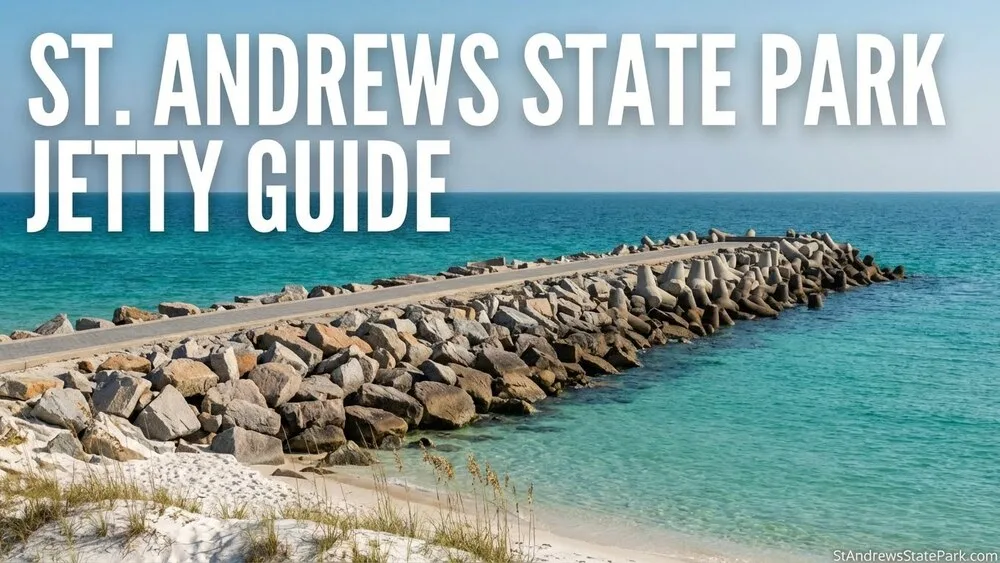
The jetties sit beside the pass connecting the Gulf with the St. Andrews Bay system. Moving water around the rocks attracts baitfish and larger predators, while the rock structure creates feeding areas and current breaks. It is one of the park’s main saltwater fishing locations.
- Fish commonly associated with the area: Spanish mackerel, redfish, bluefish, flounder, bonito and other coastal species.
- Seasonal pattern: FWC lists Spanish and king mackerel in Bay County as commonly caught from late spring through early fall.[b]
- Footing: Wear shoes with reliable traction and choose a stable fishing position on the rocks.
2. Grand Lagoon And The Fishing Piers
The Grand Lagoon side provides a different setting from the exposed Gulf shoreline. Florida State Parks lists a boat ramp and fishing pier on Grand Lagoon, while the park’s accessible-amenities information identifies two fishing piers within the park.[a]
Bay County’s inshore waters support species such as red drum, flounder, spotted seatrout and sheepshead. Live shrimp, soft plastics and other common inshore presentations are often used in this type of habitat, but the better choice changes with water conditions and the species you are targeting.
3. Surf Fishing On The Gulf Beach
The open Gulf beach gives anglers room to fish the surf rather than structure. Fish often travel along troughs, cuts and changes in depth close to the sandbars. Florida pompano are especially associated with Bay County’s coastal fishing in spring, while red drum can be caught through the year.[b]
- Pompano: Sand fleas, small crustacean-style baits and pompano jigs are common choices.
- Redfish: Can move through both surf and inlet areas.
- Reading the beach: Look for deeper troughs and breaks in otherwise uniform sandbars rather than automatically making the longest possible cast.
Fish Commonly Targeted Around St. Andrews
Florida Pompano
Florida pompano are a familiar surf target along this part of the Gulf Coast. FWC’s Bay County fishing information identifies spring as a common period for pompano catches. They often feed close to sandy bottom where small crustaceans are available.
Redfish
Redfish, or red drum, can use several of the habitats around the park, including passes, inshore water and coastal shorelines. FWC lists red drum as a year-round Bay County catch. Harvest rules are species-specific, so check the current size, bag and season rules before keeping one.
Spanish Mackerel
Spanish mackerel are fast-moving fish that can pass through the inlet and coastal water in schools. FWC identifies late spring through early fall as a common Bay County period for Spanish and king mackerel. Shiny spoons, jigs and other fast-moving lures are commonly used when fish are actively feeding.
Florida Saltwater Fishing Licenses At St. Andrews
There is no single rule saying that every person age 16 or older must personally hold the same Florida saltwater license. Residency, where you fish, how you reached the fishing location and whether a pier, vessel or charter license covers you can change the requirement. Florida also has age and other statutory exemptions.[c]
| Where / How You Fish | Florida Resident | Nonresident | Additional Check |
|---|---|---|---|
| Shore or jetty | A resident who fishes only from land or a structure attached to land may qualify for the no-cost resident shoreline-only saltwater license, unless another license or exemption applies. | The resident shoreline-only license is not available to nonresidents. A nonresident saltwater license is normally needed unless an exemption or licensed-facility coverage applies. | Check age and other FWC exemptions. |
| Licensed fishing pier | If the pier itself holds a valid Florida saltwater pier license, anglers fishing from that pier are covered by the pier license. | The same licensed-pier coverage can apply to nonresidents. | Do not assume every fishing pier is licensed. Confirm the pier’s current license status. |
| Boat | A shoreline-only license does not cover fishing from a vessel. A regular saltwater license or applicable vessel, charter or exemption coverage is needed. | A nonresident saltwater license is normally required unless the angler is covered by an eligible charter or recreational vessel license, or another exemption. | Check whether the vessel or charter license covers passengers. |
| Shell Island reached by boat | A resident shoreline-only license does not cover shoreline fishing at a place reached by boat. Use a regular saltwater license or other valid coverage unless exempt. | A regular nonresident saltwater license or other applicable coverage is required unless exempt. | The method used to reach the shoreline matters. |
| Shark fishing from shore, jetty, bridge or pier | Anglers age 16 and older targeting or attempting to take sharks from shore need the no-cost Shore-based Shark Fishing permit in addition to any required fishing license. | The same shark permit rule applies. | The educational course must be completed before obtaining the permit. There are no permit exemptions for anglers 16 and older. |
Florida residents who fish only from shore or from a structure attached to shore can obtain the state’s no-cost saltwater shoreline fishing license. It does not cover fishing from a boat, and it does not remain valid for shoreline fishing when the angler reached that location by boat. That last distinction matters around Shell Island.[d]
Nonresidents cannot use the resident shoreline-only license. FWC offers nonresident saltwater licenses for three days, seven days or one year, while several situations can provide separate coverage or an exemption—for example, fishing from a properly licensed saltwater pier or an eligible licensed charter or vessel.[e]
A Fishing Pier Is Not Automatically A Licensed Pier
St. Andrews State Park has fishing piers, but the phrase licensed fishing pier has a specific meaning under FWC licensing rules. A pier license is issued to the owner, operator or custodian and covers anglers fishing from that licensed pier.[f] If you plan to rely on pier-license coverage rather than holding your own license, confirm the current status instead of assuming any public pier provides the exemption.
Shell Island Changes The Shoreline-License Question
This is easy to miss. A Florida resident’s shoreline-only license covers fishing from land or a structure attached to land, but FWC says it does not cover a shoreline reached by boat. If you take a boat to Shell Island and then fish from the sand, the resident shoreline-only license by itself does not cover that fishing. A regular saltwater license or another applicable form of coverage is needed unless you qualify for an exemption.[d]
Shore-Based Shark Fishing Permit
Shark fishing has an additional requirement that applies directly to places such as the St. Andrews jetties. FWC requires anglers age 16 and older who take or attempt to take sharks from shore—including jetties, bridges and piers—to hold a no-cost Shore-based Shark Fishing permit in addition to any saltwater fishing license otherwise required.[g]
The permit is issued after completion of FWC’s online shore-based shark fishing educational course and must be renewed annually. Unlike the ordinary fishing-license rules, FWC states that there are no exemptions from this permit requirement for shore-based shark anglers age 16 and older, including anglers who would otherwise be exempt from purchasing a fishing license.
FWC also applies shark-specific gear and handling rules. When live or dead natural bait is used while targeting sharks, non-offset, non-stainless-steel circle hooks are required, and anglers must have a device capable of quickly cutting the leader or hook. Shark regulations also identify species that cannot be harvested, so check the current shark rules before setting out specifically for them.
Fishing Rules To Check Before You Cast
- License or exemption: Confirm the rule that applies to your residency, age, fishing location and fishing method.
- Species rules: Size limits, bag limits, closed seasons and special permits differ by species and can change.
- Park rules: Florida State Parks requires fishing inside St. Andrews to follow current rules for size, number, method of capture and season.[a]
- Tides and current: Moving water can affect fish activity around the pass, jetties and lagoon.
- Jetty footing: Wet rock, current and surf can change conditions quickly. Use suitable footwear and remain on stable surfaces.
License details can change: Check the current Florida Fish and Wildlife Conservation Commission rules before your fishing date, especially if you plan to fish from a boat, rely on a pier exemption, visit Shell Island by water, target sharks or keep regulated species.
FAQ
Does everyone age 16 or older need their own Florida saltwater fishing license at St. Andrews?
No. The rule depends on residency, fishing method and available exemptions or facility coverage. Some anglers may be covered by a licensed pier, charter or vessel, while Florida residents fishing only from shore can use the no-cost shoreline-only license. Other exemptions also exist.
Can a Florida resident use the free shoreline license at the St. Andrews jetties?
Yes, when the angler is otherwise eligible and is fishing from shore or a structure attached to shore. The shoreline-only license does not cover fishing from a vessel or a shoreline reached by vessel.
Does the shoreline-only license cover fishing on Shell Island after arriving by boat?
No. FWC states that the resident shoreline-only license does not cover shoreline fishing at a location reached by boat. A regular saltwater license or another applicable form of coverage is needed unless an exemption applies.
Do I need a special permit to fish for sharks from the St. Andrews jetties?
If you are age 16 or older and are taking or attempting to take sharks from shore, including a jetty, FWC requires the no-cost Shore-based Shark Fishing permit. The educational course must be completed before obtaining the permit.
Does fishing from a pier automatically mean I do not need my own license?
No. The exemption applies when the pier itself has a valid Florida saltwater fishing pier license. Confirm the pier’s current license status before relying on that coverage.
Sources
- [a] Florida State Parks — St. Andrews State Park Experiences & Amenities: Current park information on jetty, pier and surf fishing, commonly caught species, Grand Lagoon fishing facilities and the requirement to follow Florida fishing regulations. (Official Florida State Parks source.) Florida State Parks
- [b] Florida Fish and Wildlife Conservation Commission — Where to Saltwater Fish: Bay County seasonal information for commonly caught species including pompano, red drum, flounder, sheepshead, Spanish mackerel and spotted seatrout. (Official Florida fisheries authority.) FWC Bay County Fishing Information
- [c] Florida Fish and Wildlife Conservation Commission — Recreational Saltwater Licenses & Permits: Current license types, permit requirements and saltwater licensing structure. (Official Florida fisheries licensing authority.) FWC Saltwater Licenses & Permits
- [d] Florida Fish and Wildlife Conservation Commission — Saltwater Shoreline Fishing Information: Resident shoreline-only license rules, boat-access restrictions and shoreline exemptions. (Official Florida fisheries licensing authority.) FWC Shoreline Fishing Information
- [e] Florida Fish and Wildlife Conservation Commission — Visitors’ Licenses: Nonresident license requirements and exceptions involving licensed vessels, charters, fishing piers and free fishing days. (Official Florida fisheries licensing authority.) FWC Visitor License Information
- [f] Florida Fish and Wildlife Conservation Commission — Recreational Vessel and Saltwater Fishing Pier Licenses: Explains how a valid pier license covers anglers fishing from that licensed pier and how recreational vessel licenses operate. (Official Florida fisheries licensing authority.) FWC Vessel and Pier Licenses
- [g] Florida Fish and Wildlife Conservation Commission — Sharks: Current Shore-based Shark Fishing permit, course, age threshold, gear rules and permit-exemption information. (Official Florida fisheries authority.) FWC Shark Regulations