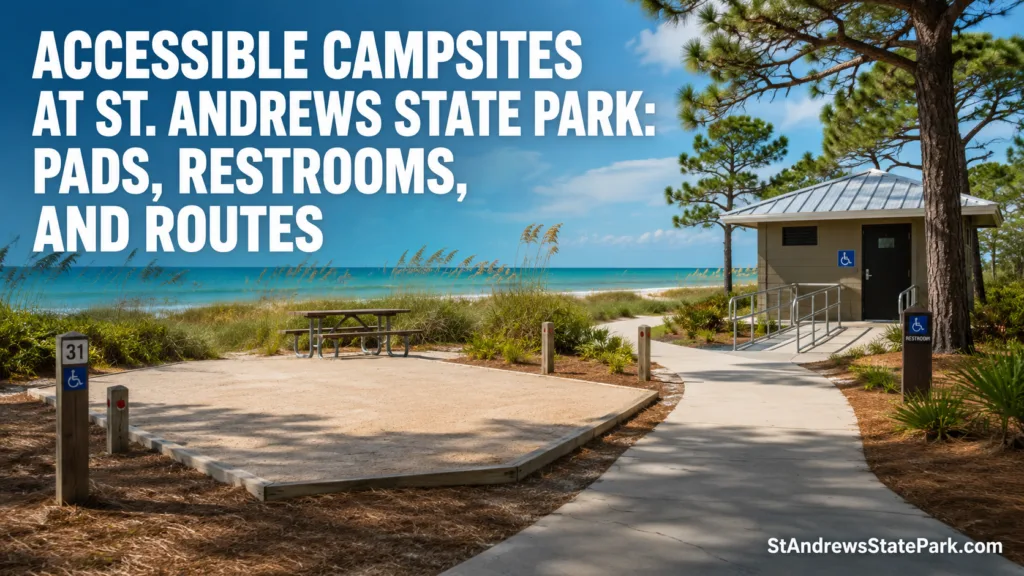
An accessible campsite can look suitable in a reservation photo and still be difficult to use once the RV door opens. At St. Andrews State Park, the useful question is not simply whether a site has a hard pad. The full test runs from the vehicle or tent entrance to the picnic area, utility pedestal, restroom door and shower. Every part of that chain needs to work for the camper’s actual mobility equipment.
The park’s official amenity listing confirms campsites with concrete pads, picnic tables, ground grills and nearby restrooms. It also states that campground sites have water, sewer, 30-amp electricity and 50-amp electricity, and that camping units up to 50 feet (about 15.2 meters) can be accommodated. Two accessible restrooms are listed for the campground.[a] Those details are useful, but they do not identify the exact site numbers, pad widths, shower layouts or route surfaces a particular camper will encounter.
♿ The Three-Part Accessibility Test
A workable reservation needs three connected pieces: enough hard-surface space at the campsite, a restroom or bathhouse that matches the camper’s needs, and a firm route between them. A failure in any one piece can turn a short trip to the restroom into the hardest part of the stay.
- Pad: Can the lift, ramp, wheelchair, walker and caregiver fit beside the camping unit?
- Restroom: Is the stall or shower usable, rather than merely located nearby?
- Route: Does the trip stay on a firm surface without an awkward road crossing, curb, steep grade or narrow turn?
What the Official Campground Information Confirms
| Campground Feature | Officially Listed | What Still Needs Confirmation |
|---|---|---|
| Campsite surface | Concrete pad | Pad dimensions, edge drop, slope and lift-side clearance |
| Site equipment | Picnic table and ground grill | Whether both sit on an accessible surface with approach space |
| Utilities | Water, sewer, 30-amp and 50-amp electric | Reach from the pad and whether hoses or cables cross the travel path |
| Camping unit length | Up to 50 feet | Fit with slide-outs, awning, lift or rear ramp deployed |
| Restrooms | Two accessible restrooms | Which sites they serve and what accessible shower features are present |
| Other facilities | Laundry and nearby park amenities | Door clearance, machine reach and route conditions |
The distinction between listed amenity and usable arrangement matters here. A concrete pad may end directly beside the RV, while the picnic table sits on grass, shell material or loose aggregate. A restroom may have an accessible stall, yet the shower may require a transfer that does not suit every visitor. Site-level confirmation matters more than a campground-wide label.
Concrete Pads and Real Transfer Space
The pad should support the entire arrival and transfer process. For a wheelchair user in a side-entry motorhome, the needed clear area is usually on the passenger side. For a rear-ramp van, the decisive space is behind the vehicle. A tent camper may need a hard route from the parking pad to the tent door. Same campground, very different geometry.
Side-Entry RV Lifts
Before reserving, compare the door and lift position with the campsite photo and site orientation. The lift needs to open fully onto a firm area, not over the pad edge. There must also be room for the platform to lower and for the wheelchair to turn away from it. A utility pedestal, grill, tree, parking stop or picnic table can take away that space even when the RV itself fits.
Slide-outs change the calculation. A 50-foot site-length allowance does not promise enough width for an RV with a slide, lift and awning on the same side. When calling the park, give the overall rig length, slide depth, lift side and the amount of side clearance needed. Specific numbers are far more useful than saying the rig is “accessible.”
Rear-Ramp Vans and Trailers
A rear ramp needs a clear landing area after the vehicle is parked. Check whether the ramp would extend toward the campground road, a neighboring site or an unpaved strip. The best arrangement keeps the ramp and its landing area inside the campsite’s usable footprint, with a direct turn toward the restroom route.
Tent Camping With Mobility Equipment
For tent campers, the vehicle pad is only the starting point. Ask whether the tent area connects to it without a soft shoulder or raised border. A tent door can face the hard surface, which reduces travel across sand or damp ground. Also worth checking: whether stakes, guylines and the ground grill would narrow the route after setup.
A Concrete Pad Is Not the Whole Campsite
The usable living area includes the picnic table, grill, utility hookups and space around the camping unit. A camper may be able to enter the RV independently but still have no practical way to reach the table. That is why connected surface matters. Look for a pad or firm path that continues beyond the parking position rather than stopping at the tires.
- Can a wheelchair approach one end or side of the picnic table?
- Is there room to turn without entering the road or loose ground?
- Can the grill be reached without crossing hoses, power cords or a drainage edge?
- Does the sewer connection require travel off the pad?
- Can a caregiver stand beside the lift or transfer point?
Utility placement often gets overlooked. St. Andrews lists full hookups at each site, including water, sewer and both 30- and 50-amp service.[a] Yet the pedestal may be behind the rig, outside easy reach or positioned where cables cross the path. Campers who need help connecting utilities should plan that task before the rest of the campsite is arranged.
🚿 Restrooms and Showers Need Separate Checks
The current park page lists two accessible restrooms and restrooms with changing areas. It does not publish a site-by-site restroom map, the distance from each reservable pad, or a feature list for the campground showers.[a] So “near the restroom” should not be treated as a complete answer.
Restroom Details That Affect Daily Use
- Entry: Step-free approach, threshold height, door weight and opening direction
- Stall: Door clearance, turning room, grab-bar placement and transfer side
- Fixtures: Toilet height, sink knee space and reach to soap or hand drying
- Companion use: Whether a family or single-user room is available
- Night access: Lighting outside the building and along the return route
Shower Details That Should Be Asked About Directly
An accessible toilet stall does not automatically confirm a roll-in shower. Ask whether the shower has a level entry, a fixed or folding seat, grab bars, a handheld shower head and controls reachable from the seat. Also ask about the dry changing area. A shower can have a wide entrance but still be awkward if clothing and mobility equipment must remain in the wet zone.
Do not confuse the lagoon boat-ramp restroom with a campground bathhouse. An official park update describes a separate restroom near the lagoon boat ramp with men’s, women’s and family facilities.[f] Its presence may be helpful during daytime activities, but the campsite-to-bathhouse route still needs its own check.
↔ The Route Is the Real Accessibility Test
A restroom that is 200 feet away may be easier to use than one 100 feet away if the longer route stays level, firm and well lit. Map distance alone hides the details that matter: surface changes, cross slopes, road crossings, curb edges and tight turns. Follow the exact path a camper would use, not a straight line drawn between two points.
For a practical reference, the 2010 ADA Standards use a 36-inch minimum clear width for many accessible walking surfaces, with limited exceptions for brief narrower sections. Ramps generally use a maximum slope of 1:12, and accessible routes call for firm, stable, slip-resistant surfaces.[d] These figures help travelers ask better questions; they are not a substitute for an on-site accessibility inspection, and outdoor recreation provisions can apply differently from ordinary building routes.
Follow the Route in This Order
- Start where the wheelchair, scooter or walker leaves the vehicle or tent.
- Check the pad edge and the transition to the campground route.
- Note every surface change, drainage dip and road crossing.
- Check the final approach to the restroom door.
- Repeat the route in the opposite direction; a mild grade one way may feel different on the return.
- Consider the same path after dark or after a coastal rain shower.
The shortest complete route usually beats the closest-looking site. A campsite beside a bathhouse may still require travel around landscaping or across the loop road. Another site may connect by a cleaner, straighter path.
Pine Grove and Lagoon Loop Context
The park’s 2016 approved management plan identified the campground as the Lagoon and Pine Grove loops. At that time, the planning inventory recorded 176 standard sites and four bathhouses. The same document described accessibility work to campground sidewalks and bathhouses, and it identified drainage needs in portions of both loops.[b]
Those numbers describe the park during the 2016 planning period, before later campground reconstruction. They should not be copied into a current reservation decision as though nothing changed. The present park page confirms the utilities and two accessible restrooms but does not repeat the old total of 176 sites or four bathhouses. Historic planning data gives context; the live reservation record gives the current site choice.
Neither loop should be declared better for every camper with a disability. A site near a restroom may suit someone with limited walking stamina, while a wider pad orientation may matter more to a side-lift RV user. The right comparison is site against site, not simply Pine Grove against Lagoon.
How Different Camping Setups Change the Choice
| Camping Setup | Pad Priority | Route Priority | Restroom Priority |
|---|---|---|---|
| Power wheelchair and side-lift RV | Wide hard surface on lift side; room to turn after lowering | Continuous firm route with enough width and no tight pinch point | Powered-device turning space and reachable door hardware |
| Manual wheelchair | Low slope and clean pad edges | Minimal grade, loose material and cross slope | Transfer-side clearance and usable shower arrangement |
| Walker or cane | Short step-free transfer from vehicle to living area | Short distance, even surface and nighttime lighting | Grab bars, dry changing space and a nearby entrance |
| Rear-ramp van | Firm landing behind the vehicle | Direct turn away from traffic | Enough space to store or position mobility equipment |
| Tent camper | Firm connection from parking pad to tent door | No soft shoulder between sleeping area and campground route | Short route that remains usable after rain |
| Camper with caregiver support | Room for two-person transfers and equipment | Space for side-by-side assistance | Companion or family restroom availability |
Rain, Sand and Nighttime Routes
Coastal campgrounds change with weather and daily traffic. Sand can migrate onto a walkway. Water may collect at a low transition. Pine needles or loose material can reduce traction. None of these conditions can be judged reliably from a single booking photo, so ask about the current route surface when the trip depends on independent wheelchair or walker travel.
Night use deserves its own question. Is the route lit from the campsite to the restroom entrance, or only near the building? Are campsite numbers easy to see? Would the user need to travel in the vehicle lane? A short daytime route can feel entirely different at 2 a.m. Simple, this point is: test the return trip in your head, not just the walk out.
Beach Access From an Accessible Campsite
The park lists elevated boardwalks to the beach, boardwalk access to the jetty overlook and beach wheelchairs available by asking at the ranger station.[a] These features widen the options beyond the campground, but they do not mean that every campsite has a continuous wheelchair route to the water.
A boardwalk may end where deep sand begins. A beach wheelchair may require another person to push, a transfer from the user’s everyday chair, and collection from a location away from the campsite. Before the trip, ask where the chair is picked up, whether it can be held in advance, what hours it is available and how it reaches the chosen beach access.
Keep Two Routes Separate
Campground accessibility covers the pad, living area, utilities and bathhouse. Beach accessibility covers transportation across the park, parking or drop-off, boardwalk approach, sand and any beach wheelchair transfer. One can work well even when the other needs assistance.
Booking an Accessible Site
Florida residents can reserve campsites up to 11 months ahead, while non-Florida residents can reserve up to 10 months ahead. New inventory opens daily at 8 a.m. Eastern Time, and canceled sites return to inventory after cancellation.[c] For a camper who needs a particular pad orientation or restroom route, booking early leaves more room to compare suitable sites rather than taking the first opening.
The reservation system may show a site as ADA or accessible, but the label cannot describe every personal need. After finding a candidate, call St. Andrews State Park at 850-708-6100 and ask staff to compare the site with the actual rig and mobility setup. Campers arriving after sunset are also instructed to call for gate access information.[e]
Questions Worth Asking Before Payment
- Is this exact site designated as accessible in the current reservation system?
- What are the usable pad width and length after the vehicle is parked?
- Which side has the broadest hard-surface clearance?
- Can a side lift or rear ramp open fully without leaving the pad?
- Does the picnic table sit on the concrete pad or on another surface?
- Which accessible restroom serves this site?
- What is the actual route distance, following the campground path?
- Does the route cross a vehicle road or include loose gravel, sand, grass or a curb?
- Does the bathhouse have a roll-in shower, seat, grab bars and handheld shower head?
- Is a companion or family restroom available within the campground?
- Are any route, restroom or campsite repairs planned during the stay dates?
- Can staff confirm the position of the power pedestal, water and sewer connections?
Write down the answers next to the site number. If two sites remain, choose the one with the shortest uninterrupted chain: vehicle exit, hard pad, living area, firm restroom route and usable bathhouse. Waterfront position is pleasant. For daily independence, layout wins.
Source Notes
- [a] Florida State Parks — St. Andrews State Park Experiences and Amenities: current statements on concrete pads, utilities, accessible restrooms, boardwalks and beach wheelchairs (reliable because it is the official park operator page).
- [b] Florida Department of Environmental Protection — St. Andrews State Park Approved Management Plan: 2016 campground inventory, loop names, accessibility work and planning notes on drainage and routes (reliable because it is the state-approved park management document).
- [c] Florida State Parks — Reservation Information: reservation windows, daily inventory release time and statewide booking rules (reliable because it is the official reservation policy page).
- [d] U.S. Department of Justice — 2010 ADA Standards for Accessible Design: route width, slope and surface reference points used to explain what travelers may wish to verify (reliable because it is the federal ADA standards publication).
- [e] Florida State Parks — St. Andrews State Park Hours and Fees: park phone, camping charges and after-sunset arrival instructions (reliable because it is the park’s official operating-information page).
- [f] Florida State Parks — Manager’s Message: completed family restroom near the lagoon boat ramp (reliable because it is an official park update).
Frequently Asked Questions
Do Accessible Campsites at St. Andrews State Park Have Concrete Pads?
The official park amenity page lists campsites with concrete pads, picnic tables, ground grills and nearby restrooms. Confirm the exact pad dimensions and lift-side clearance for the site being reserved, since the general listing does not publish those measurements.
How Many Accessible Restrooms Are Listed for the Campground?
The current St. Andrews State Park campground page lists two accessible restrooms. It does not identify every site served by each restroom, so route distance and surface should be checked for the selected campsite.
Does an Accessible Restroom Mean the Shower Is Roll-In?
No. An accessible restroom listing does not by itself confirm a roll-in shower, shower seat, handheld shower head or a particular transfer layout. Ask the park about the exact bathhouse and shower features before reserving.
Can St. Andrews State Park Campsites Fit Large RVs?
The park states that sites can accommodate camping units from tents to RVs up to 50 feet long. Campers with slide-outs, wheelchair lifts or rear ramps should also confirm usable width and landing space.
Are Beach Wheelchairs Available at St. Andrews State Park?
Yes. The park lists beach wheelchairs and directs visitors to ask at the ranger station. Availability, pickup location, transfer needs and whether another person must push the chair should be confirmed before the beach visit.
When Can an Accessible Campsite Be Reserved?
Florida residents may book up to 11 months before arrival, while non-Florida residents may book up to 10 months before arrival. New reservable inventory is released daily at 8 a.m. Eastern Time.