A campsite reservation at St. Andrews State Park covers a defined space, a limited number of people and a controlled number of vehicles. It does not turn the site into an open gathering area. Friends may visit, families may arrive in separate cars and campers may return after a day outside the park, but occupancy limits, public park hours, vehicle limits and quiet hours continue to apply.
The rules become easier to understand when three groups are kept separate: registered overnight campers, day visitors and people arriving in additional vehicles. They may spend time together at the same campsite, yet they do not all have the same access after sundown.
🏕️ Published Camping Limits
- Check-in: 3 p.m.
- Check-out: 1 p.m.
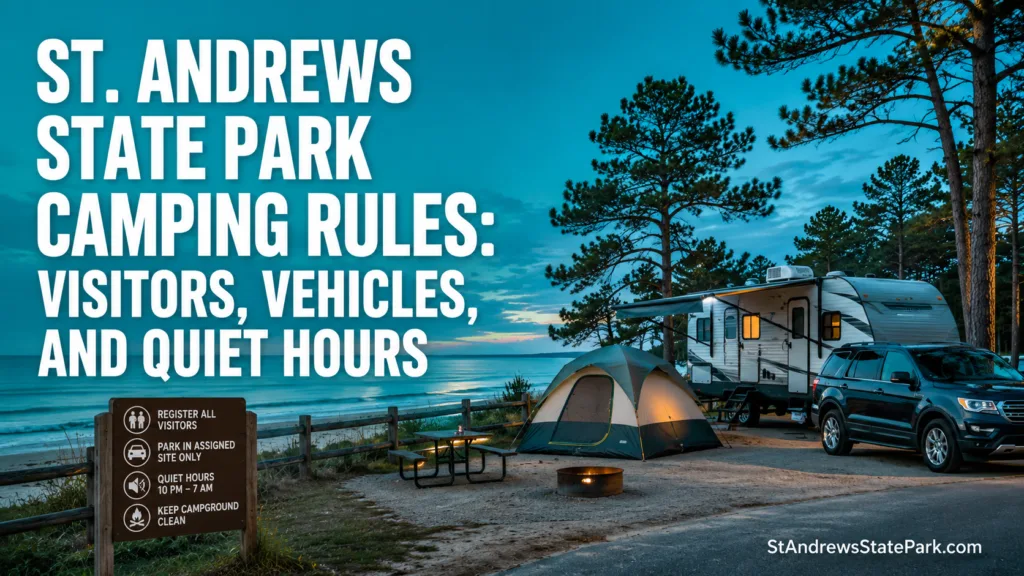
- Quiet hours: 11 p.m. to 7 a.m.
- Maximum campsite occupancy: Eight people, excluding children under age 6
- Adult supervision: At least one responsible person age 18 or older
- Vehicle limit: Two vehicles at most sites; selected sites allow only one
These limits come from the Florida State Parks camping rules and apply alongside any instructions shown for the individual St. Andrews campsite.[a]
Visitors and Overnight Occupancy
Day Visitors Do Not Become Registered Campers
A friend who drives into the park for an afternoon meal remains a day-use visitor. The person does not automatically gain overnight campground access simply because someone at the site has a reservation.
St. Andrews State Park is open to the public from 8 a.m. until sundown. The official fee page currently lists general admission at $8 for a vehicle carrying two to eight people, with separate rates for single-occupant vehicles, pedestrians and bicyclists.[b] A visiting vehicle must still follow normal entrance procedures even when its passengers are meeting registered campers.
Sundown matters here. It changes through the year, so a fixed statement such as “visitors must leave at 8 p.m.” would be inaccurate. An evening gathering that works comfortably in June may run into the public closing time much earlier in December.
👥 A Practical Distinction
A person can visit a campsite without sleeping there, but that does not remove the park entrance rules, campsite capacity or vehicle restrictions. Short visits are not exempt visits.
The Eight-Person Limit
Florida State Parks camping fees cover a maximum of eight people per campsite, not counting children younger than 6.[a] This is an occupancy rule, not a suggestion based on how many tents will fit.
Suppose six registered campers invite four friends for dinner. Even when the visitors plan to leave before sundown, ten adults gathered around one site may create an occupancy question. The published rule does not provide a separate, unlimited visitor allowance above the site capacity. For a large gathering, the ranger station should settle the permitted arrangement before guests arrive.
Two neighboring reservations do not automatically create one large shared site either. Each reservation retains its own people limit, parking allowance and physical boundary. Moving chairs between sites is simple. Moving every person, vehicle and shelter onto one pad is a different matter.
One Adult Must Remain Responsible
At least one responsible person who is 18 or older must be present at each campsite.[a] An adult making the reservation does not satisfy the rule by checking in and then leaving younger campers alone for the night.
The responsible camper also serves as the natural point of contact when a visitor parks incorrectly, a group becomes too loud or equipment extends beyond the reserved area. Several families may share the site, but the responsibility does not dissolve among them.
Vehicles and the Campsite Footprint
The Two-Vehicle Rule
Florida State Parks limits campsites to two vehicles, while selected sites permit only one.[a] The reservation record for the chosen site takes priority when it provides a lower allowance.
This rule often becomes relevant when an RV arrives with a tow car and a friend later appears in another automobile. The fact that a third vehicle can squeeze beside the picnic table does not create permission to park it there.
The same caution applies to a motorhome, pickup, travel trailer, golf cart and visitor car. Do not assume that each item belongs to a separate category that escapes the vehicle limit. The site listing and campground instructions control the final arrangement.
What Must Stay on the Gravel
The St. Andrews reservation listing requires RVs, travel trailers, campers, vehicles, tents, golf carts, utility terrain vehicles, dining shelters, picnic tables, smokers and similar large equipment to remain within the designated gravel campsite.[d]
That boundary matters even when an adjoining patch of grass looks unused. Parking a tire, stabilizer, tent corner or vehicle nose outside the pad can interfere with drainage, vegetation, sight lines and movement through the campground.
- Keep all vehicle tires off the grass.
- Do not use a neighboring empty site as extra parking.
- Leave campground roads and site entrances clear.
- Allow room for slide-outs, steps, awnings and utility connections.
- Check the complete setup length, not only the RV model length.
Small movable belongings such as bicycles, kayaks and lawn chairs may be placed outside the gravel when they do not damage the grass, according to the current reservation notice. Heavy equipment receives different treatment. That distinction is deliberate.
Boat Trailers and Overflow Parking
Boat trailers, utility trailers and similar equipment are not permitted on the individual campsites under the current St. Andrews reservation instructions. They must go to the designated overflow parking area.[d]
A boat trailer may seem narrow enough to fit behind a tow vehicle, but physical space is only half the issue. Campground rules also preserve turning room, vegetation and clear travel lanes. Arriving with both a camping trailer and a boat trailer therefore requires more planning than measuring the gravel pad.
A 50-Foot RV Limit Is Not a 50-Foot Setup Limit
St. Andrews campsites accommodate camping units ranging from tents to RVs up to 50 feet long. Current sites also provide water, sewer connections and both 30-amp and 50-amp electrical service.[c]
The published RV length does not describe the entire occupied footprint. A 38-foot fifth wheel may also bring a long-bed pickup, rear rack, extended slide-outs and an awning. Add a second car and the setup can use far more than 38 feet.
Measure these parts together:
- The RV, trailer or camper body
- The hitch or trailer tongue
- The tow vehicle
- Rear-mounted bicycles or cargo
- Open slide-outs and entrance steps
- The second permitted vehicle
- Space needed to reach utility connections safely
Long enough to accept the RV does not always mean roomy enough for every item brought with it.
Arriving After Sunset
Registered campers who expect to arrive after sunset should call St. Andrews State Park for the gate combination and arrival instructions.[b] This instruction applies to campers arriving for their reserved stay. It should not be treated as a general after-hours pass for friends, meal guests or extra vehicles.
Calling before arrival also avoids trying to solve several problems at a closed gate: confirming the site number, finding the correct loop, learning where a trailer must be parked and discovering that an additional vehicle cannot remain on the pad.
🚐 Late Arrival Is Not the Same as Late Visiting
A registered camper may receive after-hours entry instructions. A day visitor does not automatically receive the same access. Guests expected near sundown should arrive early enough to complete normal entry and parking arrangements.
Quiet Hours: 11 p.m.–7 a.m.
Quiet Time Is Not a Curfew
Campers do not have to be inside a tent or RV at 11 p.m. They may sit outside, walk to a restroom or return calmly to their site. The rule controls noise and disturbance, not ordinary movement.
Voices carry farther after dark when traffic falls away and nearby campers have turned off their equipment. A conversation that feels moderate around a daytime picnic table may sound much louder across several campsites at midnight.
During quiet hours, keep speakers off, group conversations low and vehicle activity brief. Television sound from an outdoor RV system also counts as campsite noise. So do repeated door slams, locking chirps and loud phone calls.
Late Setup Noise
Entering the campground before 11 p.m. does not guarantee that the remaining setup will be quiet. Reversing alarms, metal hitch parts, leveling blocks, stabilizer jacks and storage doors can continue well past the arrival itself.
For a late arrival, complete only what is needed for a safe overnight stay. Chairs, awnings and outdoor cooking equipment can wait until morning. Necessary setup should still be considerate setup.
- Know the site number before entering the loop.
- Store leveling blocks where they can be reached quickly.
- Use a spotter to reduce repeated backing attempts.
- Turn exterior speakers and entertainment systems off.
- Avoid leaving the engine idling while unloading.
- Dim lights once parking and connections are complete.
Early Departures
Some campers leave early for fishing, a long drive or a scheduled activity. The published quiet period still runs until 7 a.m., even when the reason for leaving is perfectly ordinary.
The rules do not state that every vehicle must remain parked until 7 a.m. An early departure should instead be handled without prolonged engine noise, trailer work or repeated loading around the site.
Pack loose equipment the previous evening. Connect a trailer before quiet time when it can be done safely, position the vehicle for a simple exit and keep keys ready. Five minutes of preparation at night can remove half an hour of noise before dawn.
Pets During Quiet Hours
Florida State Parks requires pets to be confined inside the owner’s camping unit from 11 p.m. to 7 a.m. Pets must remain leashed, confined or under physical control at other times, and a leash may not exceed six feet.[e]
For tent campers, the tent serves as the camping unit. A dog should not remain tied to a tree, picnic table or exterior cable overnight. A short, leashed restroom walk is different from leaving the animal outside for the night.
The statewide policy also limits unattended time at the campsite outside quiet hours to no more than 30 minutes. At St. Andrews, pets are welcome in the campground but are not permitted in swimming areas, buildings, beaches, wetlands, boardwalks or playgrounds. Service animals have separate access protections.[c]
Why Site Boundaries Matter at St. Andrews
St. Andrews is not a paved urban parking lot with campsites painted onto it. The campground sits within a coastal park where developed areas meet mesic flatwoods, tidal shoreline and other natural communities.
The park’s 2016 management plan recorded 14 natural community types and described the campground, marina, trails and interpretive areas as developed within the park’s mesic flatwoods. It also discussed campground drainage, shoreline conditions and the value of vegetative buffers between sites.[f]
That document is a land-management plan, not the current campground rule sheet. Still, it explains the physical logic behind keeping vehicles and heavy equipment within assigned surfaces. A few feet of grass between sites may serve as drainage space, a planted buffer or protected ground rather than spare parking.
The campground later underwent extensive rebuilding, and the current sites include gravel pads and full utility connections. The official amenities page also notes that work continues in part of the campground and that visitors must remain outside marked construction zones.[c]
Check-In and Check-Out
Standard campsite check-in begins at 3 p.m., and check-out is at 1 p.m.[a] Arriving at noon does not guarantee early possession of the site, even when the previous pad appears empty.
At check-out, the campsite must be released for the next reservation. Florida State Parks allows campers to remain in the park through the end of the day, but that permission does not extend use of the campsite beyond 1 p.m. The camping unit, vehicles and equipment must leave the reserved pad.
A camper staying for the beach after check-out should move to an approved day-use parking area and follow the parking conditions in effect there. Leaving an RV or trailer on the campsite while spending the afternoon elsewhere would prevent the next camper from using the reserved space.
Common Campsite Scenarios
| Situation | Rule That Matters | Practical Reading |
|---|---|---|
| Six campers invite four adults for dinner | Eight-person campsite capacity | A short visit does not create an unlimited allowance above the published occupancy. |
| An RV and tow car are already parked when a guest arrives | One- or two-vehicle site limit | The guest car may require approved parking elsewhere and cannot simply use the grass. |
| A family reaches the entrance after sundown | After-hours camper instructions | Registered campers should obtain the gate combination and directions before arriving. |
| A trailer arrives at 10:50 p.m. | Quiet hours begin at 11 p.m. | Access may be possible, but noisy leveling and full outdoor setup should not continue into quiet time. |
| A dog sleeps on a tether beside the RV | Pet confinement from 11 p.m. to 7 a.m. | The pet must stay inside the owner’s camping unit overnight. |
| A camper plans to leave at 5:30 a.m. | Quiet hours remain active until 7 a.m. | Pack and position the vehicle beforehand to keep the departure brief and quiet. |
| A boat trailer fits behind the motorhome | St. Andrews equipment placement rules | Boat and utility trailers belong in the designated overflow parking area. |
| Campers check out and want to use the beach | Site check-out is 1 p.m. | They may remain in the park, but the campsite must be vacated and vehicles moved to approved parking. |
Questions Before Guests Arrive
A short conversation before guests drive into the park can prevent most confusion. Settle these points while everyone still has phone service and time to change plans:
- How many people will be at the site at the same time?
- How many vehicles are already assigned to the campsite?
- Does the reservation permit one vehicle or two?
- Where will a guest vehicle go if the campsite allowance is full?
- Will the guest leave before the public park closes at sundown?
- Will any trailer require overflow parking?
- Can the entire camping setup remain on the gravel pad?
When the reservation details do not settle one of these questions, the ranger station can give an answer for the actual site. That is more reliable than applying a rule remembered from another campground.
Official Sources
- [a] Florida State Parks Camping and Cabins Guide — Statewide campsite capacity, adult supervision, check-in, check-out, quiet hours and vehicle limits. (Published by Florida State Parks, the agency operating the campground.)
- [b] St. Andrews State Park Hours and Fees — Public opening hours, admission rates and instructions for registered campers arriving after sunset. (The park’s official Florida State Parks page.)
- [c] St. Andrews State Park Experiences and Amenities — Current campsite utilities, RV length, pet access, facilities and operational notices. (Maintained by Florida State Parks.)
- [d] Florida State Parks Reservation System — St. Andrews campsite notes covering gravel-pad boundaries, equipment placement, trailer storage and overflow parking. (The official state reservation platform.)
- [e] Florida State Parks Pet Policy — Leash length, overnight confinement, unattended pets and campground conduct. (Official statewide pet policy.)
- [f] St. Andrews State Park Approved Management Plan — Natural communities, campground setting, drainage, shoreline management and vegetative buffer planning. (Approved Florida Department of Environmental Protection planning document.)
Camping Rules FAQ
What Are the Quiet Hours at St. Andrews State Park Campground?
Quiet hours run from 11 p.m. to 7 a.m. Campers may move around during that period, but voices, speakers, vehicles, setup work and other activity should not disturb neighboring sites.
How Many People Can Stay on One Campsite?
A campsite may hold up to eight people. Children younger than 6 are not included in that number. At least one responsible person age 18 or older must be present.
How Many Vehicles Can Park at a Campsite?
Florida State Parks permits no more than two vehicles at a campsite, and selected sites allow only one. The allowance shown for the reserved site should be followed.
Can Friends Visit Campers After Sunset?
The park’s normal public hours end at sundown. The published after-hours instructions apply to registered campers who have arranged gate access. They do not promise unrestricted nighttime access for day visitors.
Can a Guest Park on the Grass Beside the Campsite?
No. The current campsite instructions prohibit parking on the grass. Vehicles and large camping equipment must remain within the designated gravel site unless staff direct them to another approved parking area.
Can a Boat Trailer Stay on the Campsite?
No. Current St. Andrews reservation instructions direct boat trailers, utility trailers and similar equipment to the designated overflow parking area.
Can a Dog Remain Outside the RV or Tent Overnight?
No. Pets must be confined inside the owner’s camping unit from 11 p.m. to 7 a.m. A pet taken outside briefly must remain under the owner’s physical control and follow the leash rules.
May Campers Leave Before 7 a.m.?
The published rules establish quiet hours rather than a 7 a.m. departure ban. An early departure should be prepared in advance so engines, doors, loading and trailer equipment do not disturb other campers.