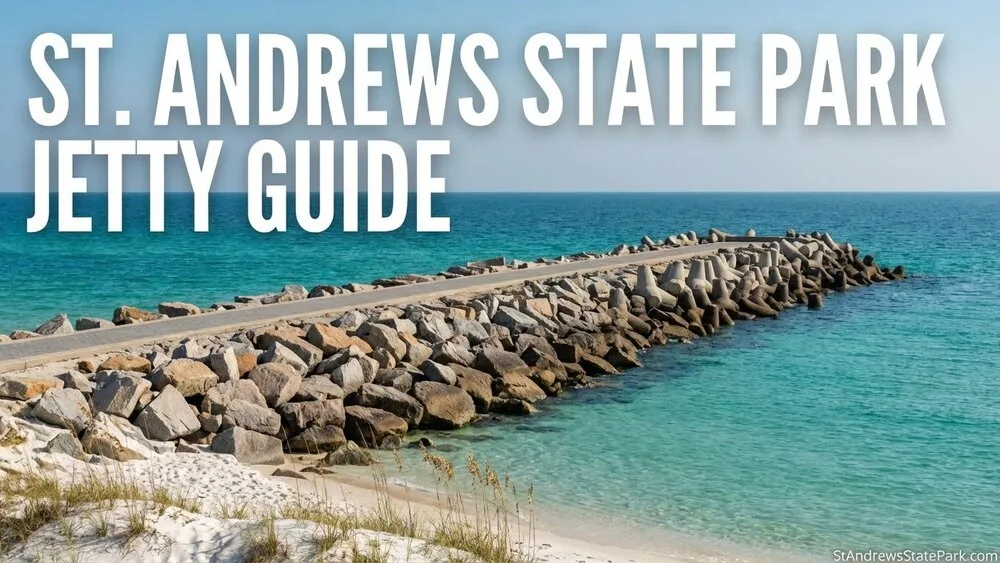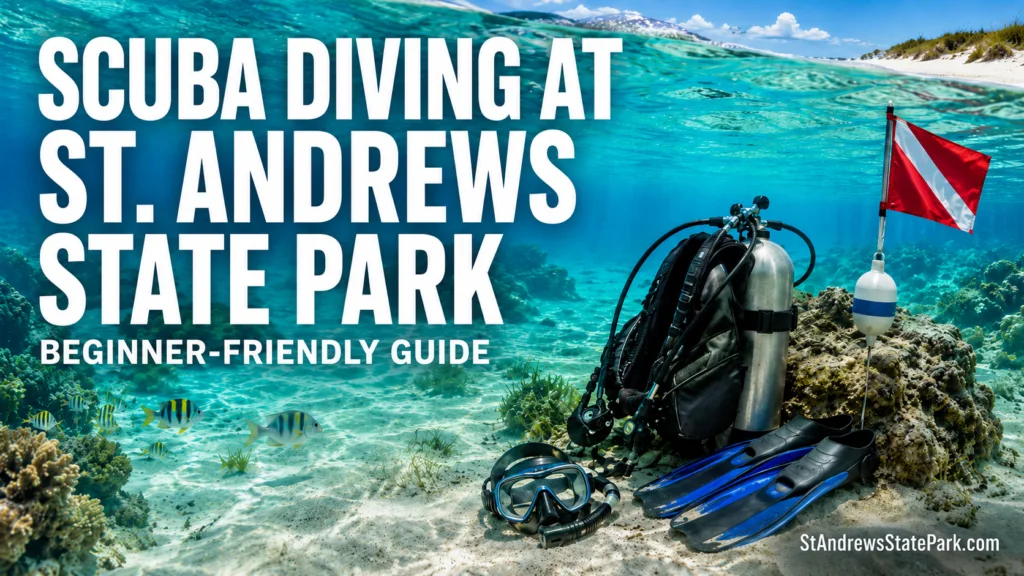
Scuba diving at St. Andrews State Park is centered around the rock jetties, where the protected inlet lagoon and open Gulf water meet. For a beginner, that matters. You are not heading straight into a remote offshore site; you are starting from a shore-access area with nearby beaches, picnic areas, restrooms, concessions, and a dive setting that changes with tide, wind, visibility, and boat traffic. Simple on paper. Still, it deserves respect.
The park officially lists scuba diving along the jetty rocks in both the inlet lagoon and the Gulf of America, and it notes that the shoreline and jetties give divers a close look at marine life [a]. For new certified divers, that makes the jetties one of the most approachable dive areas in Panama City Beach — not because the ocean is always easy, but because the site gives you options.
🤿 Beginner note: “Beginner-friendly” here means friendly for certified divers who stay within their training. Florida State Parks rules say each diver must dive within the limits of their certification, dive with a buddy, display a diver-down flag, and finish dives one hour before sunset [a].
Why The Jetties Work Well For New Divers
The jetties are the main reason divers talk about St. Andrews State Park. The rocks were built to protect the shipping channel, but over time they also became an artificial reef habitat. The official park snorkeling page describes the rock jetty as a Gulf reef setting where visitors may see rays, angelfish, redfish, sheepshead, octopus, coral, sponges, and other marine life [b].
That same structure helps scuba divers. The rocks create edges, holes, ledges, and current breaks where fish gather. You do not need a dramatic deep dive to enjoy it. A slow look along the rocks often reveals more than a fast swim over the whole area. The jetty is like a long underwater fence, and life collects around it.
| Area | What It Means For Beginners |
|---|---|
| Inlet Lagoon Side | Often the more comfortable starting point when conditions are calm and visibility is good. |
| Gulf Side | Can feel more open and exposed. Better for divers who are already comfortable with surf, current, and navigation. |
| Rock Jetty | The main structure for marine life viewing. Move slowly and avoid touching rocks, coral, sponges, or aquatic plants. |
| Nearby Beach Access | Useful for shore entry planning, surface intervals, and non-diving companions. |
| Concession Areas | Snorkeling gear is listed as available through park concessions; scuba-specific gear and tanks should be arranged before arrival [a]. |
What The Dive Feels Like
A typical beginner dive here feels more like a shore-based reef exploration than a big offshore charter. You gear up near the jetties, review the plan with your buddy or dive leader, check the diver-down flag, then enter when conditions match your comfort level. On calm days, the water can look inviting enough to fool you into rushing. Don’t.
The better rhythm is slow: enter, settle, check buoyancy, look for the rocks, then follow the structure at an easy pace. New divers often spend too much time looking forward. At St. Andrews, look beside you. Look under the ledges. Look at the sand-rock edge where small changes in bottom type attract fish.
Marine life can include reef fish, rays, sheepshead, redfish, octopus, sponges, and other nearshore species noted by Florida State Parks for the jetty area [b]. Wildlife is never guaranteed, of course. The ocean does not run on a schedule. But the habitat is there, and that is what gives the site its appeal.
Park Rules Divers Should Know
St. Andrews State Park is not a “show up and improvise” dive spot. The park has clear scuba rules, and they are practical rules, not decoration.
- Dive within your certification limits.
- Dive with a buddy. The park states that a dive party must include at least two divers.
- Display a diver-down flag.
- Finish one hour before sunset.
- Do not disturb fossils, artifacts, aquatic plants, rocks, or surfaces.
- Keep at least 50 feet from manatees.
- Spearfishing is not permitted within state park boundaries.
These rules come directly from the park’s scuba diving section [a]. For a beginner, the biggest takeaway is simple: this is a place to practice calm, careful diving — not to test limits.
⚠️ Good beginner habit: Check the tide, wind, surf, visibility, and park conditions before committing to a dive. If the site feels beyond your comfort level that day, snorkel, swim in allowed areas, or come back when the water is calmer.
Best Conditions For A First Dive Here
The best beginner conditions usually come when the water is calm, visibility is decent, and current is manageable. Local dive operators often pay close attention to tide timing around the jetties because incoming water can improve clarity. That does not mean every incoming tide is perfect. Wind direction, recent storms, boat traffic, and surf can all change the feel of the site.
Think of the jetties like a doorway between two water worlds: the lagoon and the Gulf. When water moves through that doorway, the dive changes. A certified beginner should plan the dive around conditions, not around a fixed vacation schedule.
When Beginners Should Be More Careful
- When surf is breaking near the entry area.
- When visibility looks cloudy from shore.
- When current is strong enough to make surface swimming tiring.
- When boat traffic is heavy near the inlet.
- When your buddy or group does not have a clear entry, exit, and turnaround plan.
None of this makes the park a bad beginner site. It makes it a real coastal dive site. Big difference.
What To Bring For A Beginner Shore Dive
Bring the gear required for your certification level and the local conditions. The park notes that snorkeling masks, snorkels, and fins may be available through concession stores, but scuba divers should arrange proper scuba gear, tanks, weights, and any needed rental equipment before arriving [a].
Core Dive Gear
- BCD and regulator set
- Tank and weights
- Mask, fins, and snorkel
- Exposure protection suited to water temperature
- Dive computer or timing/depth device
- Surface marker or signaling device
Site-Specific Items
- Diver-down flag
- Reef-safe sun protection
- Water for surface intervals
- Footwear for hot pavement and sandy areas
- Dry bag for keys and phone
- Printed or saved park information in case cell service is slow
Fees, Access, And Timing
St. Andrews State Park charges standard entrance fees. Florida State Parks lists admission as $8 per vehicle for two to eight people, $4 for a single-occupant vehicle, and $2 for pedestrians, bicyclists, extra passengers, and certain passholder passengers [d]. Fees can change, so check the official page before you go.
The park’s location also helps mixed groups. One person can dive while others swim, snorkel, walk the beach, picnic, or watch the water from the jetties area. That is part of the appeal. A dive morning does not have to become an all-day commitment for everyone in the car.
How The Park Setting Shapes The Dive
St. Andrews is more than a pretty beach with a dive entry. The state management plan notes that all waters within the park are designated Outstanding Florida Waters, surface waters are classified as Class III waters, and the park sits next to the St. Andrews Aquatic Preserve [c]. For divers, that background matters because the underwater area is tied to a larger coastal system, not just a recreation zone.
The same plan maps natural communities across the park, including beach dune, coastal grassland, maritime hammock, salt marsh, coastal dune lake, estuarine unconsolidated substrate, and a small area of estuarine seagrass bed [c]. You may not think about those labels while rinsing sand off your fins, but they explain why the park feels varied above and below the waterline.
The plan also lists a recreational carrying capacity of 6,860 users per day for the park [c]. On busy beach days, that number makes sense. For a beginner diver, it is a reminder to arrive early, park with patience, and avoid rushing gear setup when the jetties area is active.
Marine Life And Low-Impact Diving
The best beginner divers at St. Andrews are usually the quietest ones underwater. They trim out, move slowly, and let the rocks do the work. Fish often hold near structure. Octopus, sponges, and small reef life reward careful eyes. Fast finning stirs sand and scares away the small details.
Florida State Parks asks divers not to trample or disturb aquatic plants and not to deface rocks or other surfaces [a]. That is easy to follow with good buoyancy. Keep fins up, avoid standing on submerged rocks, and use hand contact only when needed for safety. A beginner who protects the site also protects the quality of future dives.
🌊 Small detail that matters: The DEP has hosted underwater cleanup activity at the St. Andrews jetties, with one event page noting that the previous two cleanups removed about 350 pounds of marine debris, mainly discarded monofilament [e]. If you see line or debris underwater, do not pull at anything wrapped around rocks or habitat unless you are trained and equipped to handle it safely.
Is St. Andrews Good For A First Ocean Dive?
For many certified beginners, yes — when conditions are calm and the dive plan is conservative. It can work well as an early ocean dive because shore access keeps the logistics simple, the jetties provide a clear visual feature, and the marine life starts close to the structure.
But the site is still coastal water. Current, surf, boat movement, and visibility can change the day quickly. If your last dive was in a pool or a still freshwater site, consider going with a local dive professional or an experienced buddy who knows the jetties. No shame in that. Good divers make boringly smart choices.
A Sensible Beginner Profile For This Site
- You are already scuba certified.
- You are comfortable with shore entries and exits.
- You can control buoyancy without kneeling on the bottom.
- You can navigate with a buddy and return with enough gas reserve.
- You are willing to cancel or switch plans if conditions do not look right.
Common Beginner Mistakes At The Jetties
Most mistakes here are simple, and simple mistakes are the easiest to avoid.
- Entering too quickly. Watch the water first. A few minutes of observation can save a messy start.
- Forgetting the surface plan. Know where you will exit if the current or visibility changes.
- Overweighting. Extra lead makes buoyancy harder near rocks and sand.
- Chasing wildlife. Let marine life move naturally. You will often see more by staying still.
- Ignoring the clock. Park rules require dives to be completed one hour before sunset [a].
Who Should Choose A Guided Dive
A guided shore dive makes sense if you are newly certified, visiting from outside Florida, unfamiliar with diver-down flag rules, or unsure how tide and current affect the jetties. It also helps if you are diving with a camera, because a guide can slow the pace and point out small marine life you might swim past.
Experienced divers may be comfortable planning their own dive. Beginners usually enjoy the site more when the logistics are handled calmly: where to gear up, where to enter, which side to use, when to turn around, and where to exit. Less guessing. Better dive.
Scuba Diving And Snorkeling Compared
St. Andrews is also known for snorkeling, and the park describes the rock jetty as one of the best snorkeling spots in West Florida [b]. If you are not certified, snorkeling is the right way to enjoy the water. You still get the jetties, the fish, the clear-water moments, and the beach setting — without pretending scuba is casual.
| Activity | Best For | Training Needed |
|---|---|---|
| Snorkeling | Surface viewing near the swimming areas and jetty when conditions allow. | Comfort swimming; no scuba certification. |
| Scuba Diving | Certified divers who want to explore the jetty rocks below the surface. | Scuba certification and proper dive gear. |
| Guided Shore Dive | Newly certified divers or visitors who want local site support. | Scuba certification, plus guide/operator requirements. |
FAQ About Scuba Diving At St. Andrews State Park
Can beginners scuba dive at St. Andrews State Park?
Yes, certified beginners can dive here when conditions are calm and they stay within their certification limits. The park’s scuba rules require divers to dive within their certification, use a buddy system, display a diver-down flag, and finish one hour before sunset.
Where do people scuba dive in the park?
The main scuba area is along the rock jetties, including the inlet lagoon side and the Gulf side. The jetties create structure that attracts marine life and gives divers a clear feature to follow.
Do I need to be certified to scuba dive here?
Yes. The park states that each diver must dive within the limits of their certification. Non-certified visitors should choose snorkeling or swim in designated areas instead of scuba diving.
Is scuba gear available inside the park?
The park lists snorkeling equipment such as masks, snorkels, and fins as available through concession stores. Scuba divers should arrange tanks, weights, regulators, BCDs, and other scuba equipment before arrival unless they have confirmed rentals with a local dive provider.
What marine life can divers see near the jetties?
The jetty area is known for marine life such as rays, angelfish, redfish, sheepshead, octopus, coral, sponges, and other nearshore species. Sightings vary with season, visibility, tide, and water movement.
Can I spearfish while scuba diving in St. Andrews State Park?
No. Florida State Parks lists spearfishing as not permitted within state park boundaries.
Sources
- [a] Florida State Parks — St. Andrews State Park Experiences & Amenities (official park source for scuba diving location, diver rules, concessions, and amenities)
- [b] Florida State Parks — Snorkeling at St. Andrews State Park (official park source for jetty reef description and marine life examples)
- [c] Florida Department of Environmental Protection — St. Andrews State Park Approved Unit Management Plan, 2016 (official DEP management plan for park waters, natural communities, land use, and carrying capacity)
- [d] Florida State Parks — St. Andrews State Park Hours & Fees (official park source for entrance fees and visitor fee categories)
- [e] Florida Department of Environmental Protection — Dive Cleanup at St. Andrews State Park Jetties (official DEP event page noting underwater cleanup activity and debris totals)