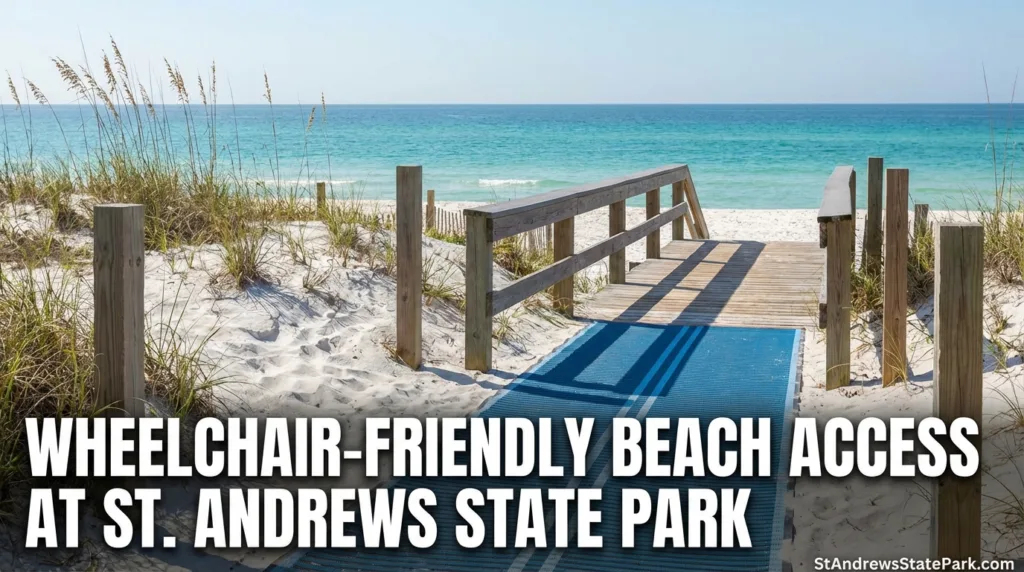
Wheelchair-friendly beach access at St. Andrews State Park is real, though it works in a very coastal-park way rather than a city-boardwalk way. The official amenities page lists elevated boardwalks to the beach, beach wheelchairs available through the ranger station, restrooms with changing areas, accessible picnic facilities, two fishing piers, and accessible overlooks in other parts of the park[b]. The beach page adds one detail that matters right away: the mainland shoreline is reached from two different parking areas, and the boardwalks are there to protect the dunes while still giving visitors an easier path across them[c].
That difference is easy to miss. Can you roll from the car over a hard surface all the way into open sand and water? Not really the promise here. What the park does offer is a much more usable setup than a raw dune crossing: developed mainland arrival points, raised access routes over fragile beach habitat, and specialized beach chairs for the softer terrain once the firm surface ends[b]. For many visitors with mobility needs, the mainland side is the simpler place to start because Shell Island is reached by boat, while the mainland beaches are the ones the park describes with parking-area access and boardwalk entry[c].
♿ The clearest reading of the official park information is this: the mainland beach access points are the most straightforward choice for visitors who want firmer arrival surfaces, nearby facilities, and help from the ranger station if a beach wheelchair is needed[b].
Where Beach Access Works Best
| Area | What Official Sources Confirm | Why It Matters For Mobility Access |
|---|---|---|
| Mainland Beach Access | Two parking areas serve the beach, and boardwalks lead visitors across the dune line[c] | The arrival is more structured and predictable than an undeveloped shoreline entry |
| jetty / Gun Mount Side | Elevated boardwalks reach the beach and the jetty overlook, with nearby restrooms and picnic areas listed among accessible amenities[b] | Good for visitors who want views, fresh air, and beach atmosphere without relying only on open sand |
| Ranger Station Support | The park lists beach wheelchairs and tells visitors to inquire at the ranger station[b] | Helpful when the boardwalk ends and soft sand begins |
| Beyond The Beach | Accessible amenities also include two fishing piers, Gator Lake overlook, Buttonbush Marsh overlook, campsites with concrete pads, and restrooms with changing areas[b] | A park day here does not have to stop at the shoreline |
The phrase wheelchair-friendly beach access can mean a lot of different things from one Florida park to another. At St. Andrews, it means the built part of the trip has been thought through. You are not being left to guess where the easier dune crossings are, and you are not limited to a single paved viewpoint. The official amenities list spreads access across the park: beach entry, overlooks, piers, picnic areas, restrooms, and camping support all appear in the same access picture[b].
Mainland Beach Entry Versus Shell Island
This is one of the most useful distinctions to make, and many articles skip it. The official beach page describes easy access to the mainland beach from two parking areas, while Shell Island is framed as a separate trip by ferry or paddle in spring and summer[c]. Beautiful trip? Yes. The more practical starting point for wheelchair users focused on stable arrival conditions? The mainland side, almost always.
That does not make Shell Island irrelevant. The park’s management plan notes earlier access-related work that included three accessible wheelchairs for day-use areas and Shell Island[a]. Still, the public-facing amenities page today simply tells visitors to ask at the ranger station about beach wheelchairs[b]. Read together, those sources point to a sensible move: if island access matters for your visit, confirm the exact setup before you arrive.
What Happens After The Boardwalk
Here is the honest part. The boardwalk solves the dune crossing. It does not turn a natural beach into a hard-surface promenade. That is exactly why the park’s current amenities page lists both elevated boardwalks and beach wheelchairs in the same section[b]. One gets you across protected coastal terrain with less effort. The other helps with the loose sand that makes barrier-island beaches feel like real beaches, not built plazas.
🏖️ What stands out here is the balance. Access routes are improved, but the park still protects the dune system that makes St. Andrews feel like St. Andrews. The beach page says the boardwalks give access while keeping the delicate dune ecosystem intact[c].
What The Park Layout Adds
The park’s approved management plan fills in details the shorter visitor pages do not spell out. On the mainland, the Gulf Pier Use Area is listed with a 440-foot fishing pier, a beach access path, restrooms, an outside shower, and parking inventory of 210 standard plus 13 oversized spaces. The Jetty Use Area includes three dune-crossover boardwalks, a beach overlook, restrooms, and 340 standard parking spaces. The Lagoon Use Area includes the boat ramp and basin, a 125-foot fishing pier, restroom, playground, grills, tables, and paved parking noted as 28 standard plus 18 oversized spaces, plus overflow space for vehicles with trailers[a].
Those numbers are not a count of marked ADA spaces, so they should not be read that way. What they do show is the physical shape of the park’s developed use areas. Big day-use nodes. Built facilities. Multiple arrival choices. For anyone trying to understand whether St. Andrews is a random stretch of sand or a park with real access infrastructure, that layout answers the question fast[a].
Access Improvements The Plan Records
- Three accessible wheelchairs were added for the day-use areas and Shell Island[a]
- Seven boardwalks were repaired, and four of them were made accessible, including nature trail boardwalks[a]
- Accessible handrails were added through day-use and campground facilities[a]
- Concrete sidewalks in the day-use and campground areas were remodeled to meet current accessibility standards[a]
- Paved accessible parking was added for Gator Lake and Buttonbush Marsh[a]
- The lagoon restroom and bathhouses 1 and 2 were modified for ADA access[a]
That list matters because it shows access at St. Andrews is not just a single beach wheelchair sitting in storage. The park plan describes a wider pattern: boardwalk work, handrails, parking changes, sidewalk upgrades, and restroom changes spread across the site[a]. Piece by piece, that is how a beach park becomes easier to use.
Access Beyond The Sand
Some visitors come for the water. Others want a park that still feels worth the trip even if the shoreline itself is not the only goal. St. Andrews is stronger than average on that second point. The official accessible amenities list includes two fishing piers, the jetty overlook, the Gator Lake overlook, the Buttonbush Marsh overlook, picnic facilities, and restrooms with changing areas[b]. That gives the visit more range. Nice to have, and more than that.
The campground side adds another layer. The park currently lists campsites with concrete pads, picnic tables, ground grills, and nearby restrooms among its accessible features[b]. The campground page also notes two accessible restrooms and utility-equipped sites[b]. So if your beach day also includes a longer stay, the access picture does not fall apart once you leave the shore.
Hours, Fees, And Mobility Details Worth Checking
The current park page says St. Andrews is open 8 a.m. to sundown, 365 days a year. Daily admission is listed as $8 per vehicle for two to eight people, $4 for a single-occupant vehicle, and $2 for pedestrians, bicyclists, and certain extra passengers[d]. Those are ordinary visit details, yet they matter here because beach access works better when arrival is smooth and unhurried.
If you use a beach wheelchair, the official park page says to inquire at the ranger station[b]. If you bring your own power-driven mobility device, Florida State Parks says wheelchairs and manually powered mobility aids are allowed anywhere foot traffic is allowed, while OPDMD users should call before they go and stay within usual park-system limits of walking speed up to 5 mph, width around 34 inches, length around 62 inches, and weight around 550 pounds[e].
That statewide policy does not replace site-specific judgment. St. Andrews is still a coastal park with dunes, changing sand, weather, and busy beach-use areas. Even so, the current public material gives a clear picture: boardwalk access on the mainland, support equipment through the ranger station, and a wider set of accessible facilities across the park[b]. For a Florida Panhandle beach park, that is a solid access setup.
Source Notes
- [a] St. Andrews State Park Approved Plan (PDF) – Used for the park layout, parking inventory, pier lengths, boardwalk counts, accessible parking work, ADA restroom updates, and the historical list of access improvements at the park (official Florida Department of Environmental Protection planning document, so it is a primary state source).
- [b] St. Andrews State Park Experiences & Amenities – Used for the current public list of accessible amenities, beach wheelchairs, overlooks, piers, picnic areas, restrooms, and campground access details (official Florida State Parks park page, maintained by the state park system).
- [c] Beaches At St. Andrews – Used for the mainland beach access description, the two parking-area setup, boardwalk access across dunes, and the distinction between mainland beach use and Shell Island access (official Florida State Parks educational page tied to the park).
- [d] St. Andrews State Park Hours & Fees – Used for current opening hours, entry fees, and visitor timing details (official Florida State Parks visitor-information page, which is the state’s direct source for current park operations).
- [e] Florida State Parks Wheelchair / OPDMD Policy – Used for the park-system rules on wheelchairs, manually powered mobility aids, power-driven mobility devices, and the recommendation to call ahead (official statewide policy page from Florida State Parks).
- [f] St. Andrews State Park Map (PDF) – Used for map-based orientation of the mainland use areas, Shell Island relation, and the main visitor nodes shown in the park layout (official Florida State Parks map published for visitor use).
FAQ
Does St. Andrews State Park have beach wheelchairs?
Yes. The current amenities page lists beach wheelchairs and says visitors should inquire at the ranger station[b].
Is the beach route paved all the way to the sand?
No official page says that. What the park does say is that it offers elevated boardwalks to the beach and also offers beach wheelchairs[b]. That tells you the firm route helps across the dunes, while the final sandy section may still call for specialized equipment.
Which part of the park is the easiest place to start for wheelchair users?
The mainland side is the simpler starting point for many visitors because the official beach page describes two parking areas for mainland beach access and says boardwalks lead visitors across the dune line[c].
Is Shell Island the main accessible beach option?
Usually, no. Shell Island is reached by boat, while the mainland beach areas are the ones the park directly describes with parking-area access and boardwalk entry[c]. The management plan does record earlier accessible wheelchair additions tied to day-use areas and Shell Island, so calling ahead makes sense if island access matters to your visit[a].
Can I bring my own power-driven mobility device?
Florida State Parks allows OPDMD use for people with mobility disabilities, but the statewide policy asks visitors to call ahead and notes usual limits for speed, width, length, and weight[e]. At a natural beach park, that step is worth taking.