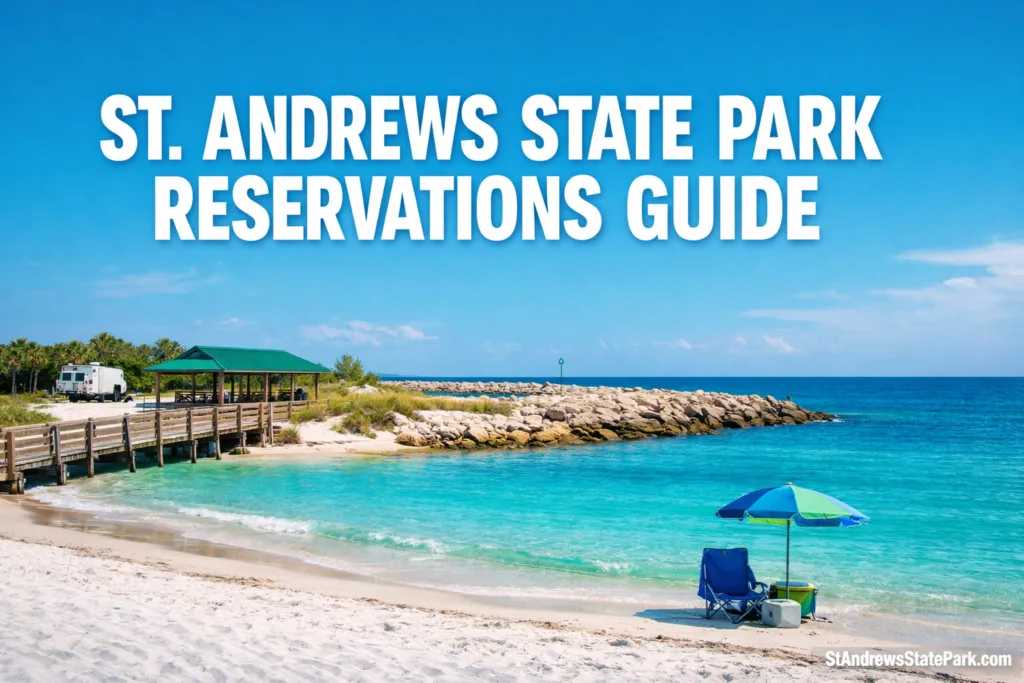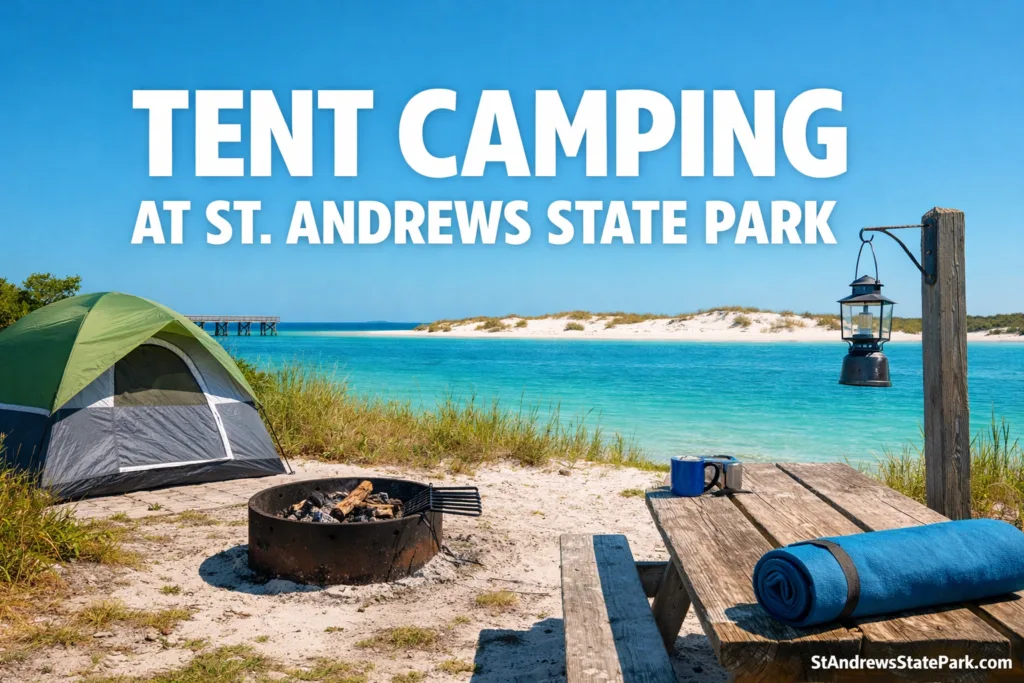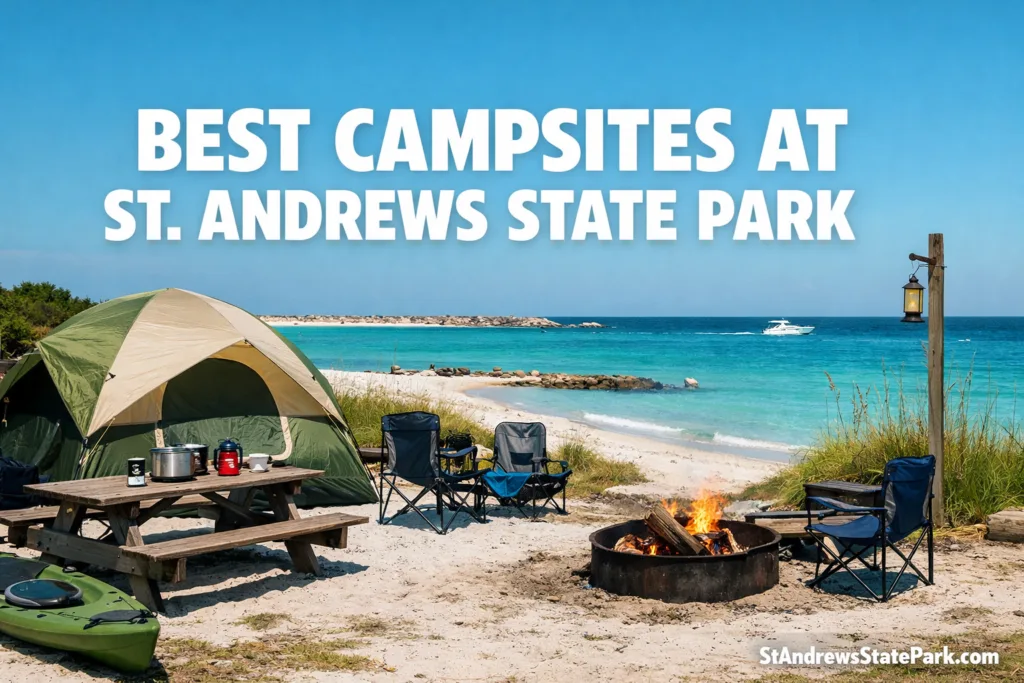
Not every campsite at St. Andrews State Park gives you the same stay. Some pads put Grand Lagoon right beside your chair. Some feel quieter near the entrance side. Others place you closer to the boat ramp, fishing pier, and the water-focused heart of the park. For me, the campsites worth targeting first are the ones that do more than hold an RV or tent. They make the park feel close the moment you step outside, and that is where St. Andrews separates itself from an ordinary beach campground.[a]
⛺ What Makes One Site Better Here
- Direct lagoon frontage matters most. At this park, the strongest pads are often the ones where the water becomes part of the campsite, not just part of the background.
- Loop position changes the feel of your stay. The Pine Grove side and the Lagoon side do not function the same on the park map.
- Water access is a real separator. A small group of numbered sites is specifically noted in the state paddling material as waterfront spots where a kayak can be landed.
🌊 Where The Strongest Campsites Are
| Area Or Site Type | Best For | Why It Stands Out |
|---|---|---|
| Waterfront-numbered campsites | Campers who want the lagoon right at the site | These are the numbers specifically identified by the state paddling material as water-edge campsites where a kayak can be landed. |
| Pine Grove side | A calmer base with a little more separation from the park’s busier water-use zone | On the official park map, Pine Grove sits nearer the entrance and visitor center side of the campground layout. |
| Lagoon side | Shorter access to the boat ramp, fishing pier, tour dock, and the more active lagoon-facing part of the park | The official map places Lagoon Campground beside the shoreline near those day-use features. |
| Any standard full-hookup site | Tent campers, travel trailers, and RVs that value utility consistency more than a water-edge pad | The park’s standard campsites all share the same basic utility package, so the real difference usually comes down to position rather than hookups. |
🚣 Waterfront Campsites Deserve First Look
The clearest starting point is the waterfront group. Florida DEP’s Segment 3 paddling material calls out even-numbered sites 16–38, even-numbered sites 96–114, plus sites 101, 132, 134, and 143 as campsites on the water where a kayak can be landed. That one detail tells you a lot. These are the pads where the lagoon feels immediate, where sunrise and evening light work harder for you, and where the campsite itself becomes part of the experience instead of just the place you sleep. One thing to remember: a waterfront site is not always a perfectly smooth shoreline edge. The same state document notes that some of these numbers may have rip-rap or marsh grass in front, so the most scenic site and the easiest kayak pull-up are not always the exact same thing.[d]
🌲 Pine Grove Side Feels More Settled
On the official park map, Pine Grove Campground sits closer to the entrance station and visitor center side of the campground layout. That usually makes it the better pick for campers who want a site that feels a bit more tucked into the inland side of the park, with a little less day-use motion around them. It is still St. Andrews, still close to the water, still part of the same bay-and-beach setting. Just a different rhythm, quieter often, more settled in feel, and easier to appreciate when your priority is a calm basecamp rather than the shortest possible walk to the marina-facing activity.[e]
⚓ Lagoon Side Puts You Closer To The Action
Lagoon Campground sits where many campers naturally want to be: nearer the shoreline, the boat ramp, the fishing pier, the tour boat dock, and the concession/store area shown on the park map. That placement makes a real difference. A site on this side works better for campers who plan to be out on the water early, who expect to move between campsite and lagoon facilities more than once a day, or who simply like staying in the part of the campground that feels most connected to Grand Lagoon. For a first visit, this is the side I would study hardest on the reservation map.[f]
📍 The site-choice logic at St. Andrews is simple: chase the water-edge numbers first, then choose between a quieter Pine Grove position or a more active Lagoon-side position. Once you know which of those three experiences fits your trip, the reservation screen becomes much easier to read.
🔌 What Every Standard Campsite Includes
One reason this campground is easy to like is that the basics are not skimpy. The park states that each campsite includes water, 30- and 50-amp electric, and sewer hookups, along with a picnic table and grill. The campground can handle camping units from tents to RVs up to 50 feet in length. Accessible restrooms are available, laundry is available, and pets are welcome in the campground, though they are not allowed in swimming areas or buildings. That matters here because the “best site” question is less about utilities and more about position, water feel, and how you plan to use the park.[b]
📅 Reservation Timing Shapes Your Options
At a park like this, your campsite strategy starts before you ever drive through the gate. Florida State Parks says Florida residents can reserve campsites up to 11 months ahead, while non-Florida residents can reserve up to 10 months ahead. New inventory opens daily at 8 a.m. Eastern, and any unreserved or unoccupied site may be rented to walk-in campers. The same reservation information also notes that late arrivals should call the park before 5 p.m. local time for gate instructions. At St. Andrews, that timing matters because the more desirable water-oriented pads are the ones most campers will study first.[c]
🏖️ Why These Campsites Feel Different From Many Florida Beach Campgrounds
St. Andrews State Park works because it is not just a campground near a beach. It is a large state park of more than 1,200 acres with about a mile and a half of beach, and the park promotes it as a place where five ecological landscapes meet in one location. That layered setting is why campsite position matters more here than it does at many plain RV parks. You are not choosing between one paved pad and another identical paved pad. You are choosing how close you want to feel to Grand Lagoon, how fast you want to reach the boat facilities, and how much of the park’s bay-and-beach geography you want woven into the stay itself.[g]
🌿 The Water Beside Your Site Is Part Of The Story
The bay around the park is not empty blue space. Florida DEP’s current aquatic preserve material notes that three seagrass species occur in the preserve and that staff are using monitoring, GIS work, restoration planning, and boat-ramp education to protect that habitat. That is a useful modern lens for campsite choice. A water-edge site at St. Andrews is not only about the view. It also puts you beside one of the park’s living systems, which is part of why these campsites feel so much more rooted in place than a standard roadside campground.[h]
❓ Questions People Usually Ask
Which campsites are the best for a lagoon view?
The strongest picks are the waterfront-numbered sites noted in the Florida DEP paddling material: even-numbered sites 16–38, even-numbered sites 96–114, plus 101, 132, 134, and 143. They are the best starting point for campers who want the lagoon to feel close and usable, not just visible.
Is Pine Grove or Lagoon the better campground side?
Neither side wins for every trip. Pine Grove generally suits campers who want a calmer feel closer to the entrance side. Lagoon suits campers who want quicker access to the boat ramp, fishing pier, dock, and the more active lagoon-facing part of the park.
Are all standard campsites full hookup?
Yes. Florida State Parks says the standard campsites have water, 30- and 50-amp electric, and sewer hookups, plus a picnic table and grill.
Can tents stay here, or is it mainly for RVs?
Both work. The park says the campground accommodates camping units ranging from tents to RVs up to 50 feet in length, so site choice comes down more to location than to whether you camp soft-sided or hard-sided.
How early should you reserve?
The earlier the better for top-positioned sites. Florida residents can book up to 11 months ahead, non-residents up to 10 months ahead, and new inventory opens daily at 8 a.m. Eastern.
Source Notes
- [a] Florida State Parks — St. Andrews State Park — used for park setting, beach length, location, and the park’s overall campground context. (Official Florida State Parks page.)
- [b] Florida State Parks — Experiences & Amenities — used for campsite utilities, rig length, laundry, and campground pet rules. (Official park amenity page.)
- [c] Florida State Parks — Reservation Information — used for reservation window, daily release time, walk-in availability, and after-hours arrival instructions. (Official statewide reservation policy page.)
- [d] Florida DEP — Segment 3 Panama City Beach/St. Andrews Bay — used for the numbered waterfront campsites and the note that some shoreline spots may have rip-rap or marsh grass in front. (Florida Department of Environmental Protection document.)
- [e] Florida State Parks — St. Andrews State Park Map PDF — used for the Pine Grove and Lagoon campground positions on the official park map. (Official park map PDF.)
- [f] Florida State Parks — St. Andrews State Park Map PDF — used for the Lagoon-side relationship to the boat ramp, fishing pier, tour dock, and shoreline facilities. (Official park map PDF.)
- [g] Florida DEP — Segment 3 Panama City Beach/St. Andrews Bay — used for park acreage and the bay-focused ecological setting around the campground. (Florida Department of Environmental Protection document.)
- [h] Florida DEP — St. Andrews Aquatic Preserve: Protection of Seagrass Habitat — used for current seagrass habitat protection work and the three seagrass species in the preserve. (Official Florida DEP aquatic preserve page.)