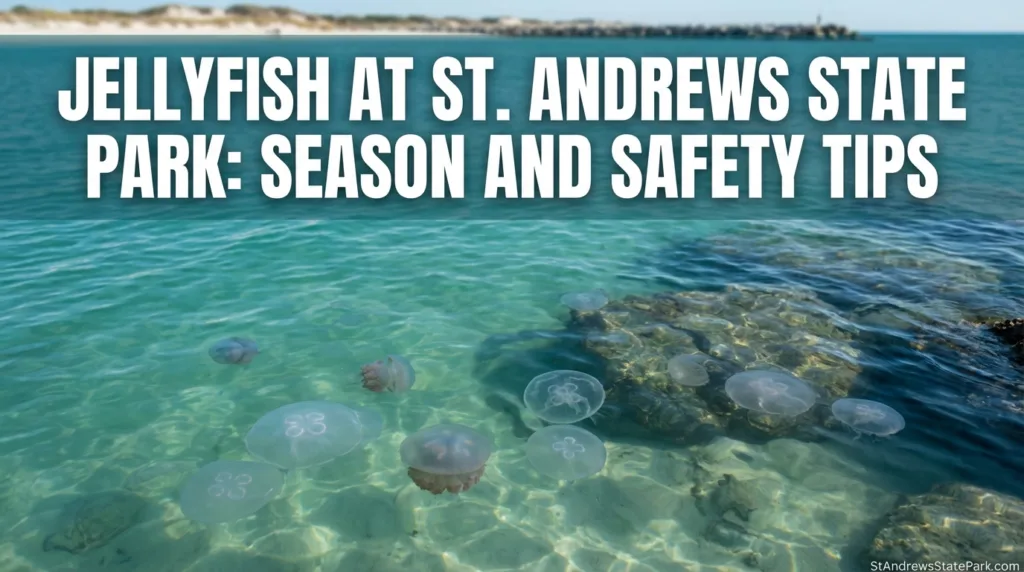
Jellyfish at St. Andrews State Park are less about one fixed month and more about water conditions. That is what makes this park a little different. You have open Gulf beach, a jetty area with protected water, and calmer bay-side access all tied to the same park system. Some days the water looks clear and easy, and it is. Other days, the same clear water makes jellyfish easier to spot. If you want the short, honest version, here it is: watch the flags, watch the water, and treat wind and tides as part of the story, not background noise.
🪼 What matters most here: daily conditions. At St. Andrews State Park, jellyfish presence can shift with tide, current, and wind, so one side of the park can feel very different from another on the same day.[e]
Why This Park Feels Different
St. Andrews State Park is not just one straight beach. The official park page places it between the Gulf and St. Andrews Bay, with more than 1.5 miles of beaches spread across the Gulf and Grand Lagoon side.[a] The park’s management plan adds more detail: it contains 14 natural communities, includes the mainland and part of 690-acre Shell Island, and is the only Florida state park that manages land on both sides of a major navigation inlet.[b] That layout shapes how people experience marine life. It shapes jellyfish days, too.
The park also sits in a very clear-water setting. The management plan describes St. Andrew Bay as a high-salinity estuarine system with relatively low sediment load and low turbidity, helped by spring-fed tributaries, seagrass beds, and marsh filtering.[b] For swimmers and snorkelers, that often means better visibility. Helpful, yes. But it also means you may be able to see jellyfish more clearly when they drift in, especially around the jetty and nearshore water.
There is another local detail worth knowing. The jetties and navigation channel changed the shape of the place long ago. The park plan notes that a jetty-armored inlet was cut in the 1930s, separating the old peninsula and creating Shell Island as we know it today.[b] So when people talk about St. Andrews like it is one simple beach, they miss the point a bit. It is a mixed coastal system, and marine life moves through it that way.
When Jellyfish Are More Likely
Ask when jellyfish season starts, and the most careful answer is this: there is no single park-wide calendar that tells the whole story. Visitors around the Florida Panhandle tend to notice jellyfish more during the warmer part of the year, but local extension guidance keeps coming back to the same point — wind, tide, and current often matter as much as the month itself.[e] In other words, a date on the calendar helps a little. Water movement helps more.
UF/IFAS notes that some locally common stinging species along Panhandle shores include the moon jelly, sea nettle, and cannonball jellyfish. It also notes that Portuguese man-of-war can show up on local shores after sustained southerly winds in summer.[f] That does not mean every warm-weather day at St. Andrews will bring a sting problem. It means warm months plus the right push from wind and current can change the water quickly.
A recent local signal matters here as well. In September 2024, UF/IFAS reported jellyfish near the Panama City Beach shore serious enough to trigger purple flag warnings for dangerous marine life in the area.[d] So yes, recent seasons have shown exactly why visitors should treat jellyfish as a live beach condition, not an abstract summer talking point.
Beach Flags Worth Watching Before You Swim
Panama City Beach uses a public flag system that is easy to ignore when the water looks calm. Better not to. The city’s official flag page says a purple flag means dangerous marine life, and a double red flag means the water is closed to the public.[c]
| Flag | Meaning | What It Means For Jellyfish Days |
|---|---|---|
| Double Red | Water closed to the public | Do not enter the water, even if the beach looks inviting. |
| Red | High hazard | Strong surf or currents can make spotting and avoiding marine life harder. |
| Yellow | Medium hazard | Conditions may still change during the day, especially around the jetty. |
| Green | Low hazard | Low hazard does not mean no jellyfish. |
| Purple | Dangerous marine life | Slow down and scan the water carefully; jellyfish are a common reason for this flag. |
The same official page also says you can sign up for flag alerts by texting PCBFLAGS to 888777.[c] That is one of the simplest safety moves you can make before a beach day at St. Andrews.
Where Swimmers Tend To Notice Jellyfish Most
Gulf Beach
The Gulf side is where surf, wind push, and open-water drift become more obvious. UF/IFAS notes that jellyfish numbers can shift from one side of a coastal system to another with tides, and other marine science guidance explains that jellyfish often collect along windward shorelines or where moving water meets an obstacle.[e][h] So if the open beach suddenly seems peppered with jellies, that does not always mean the whole park is the same.
Jetty Area and Protected Pool
The jetty is one of the park’s best-known water access points. Florida State Parks describes the rock jetty as one of the stronger snorkeling spots in West Florida, functioning like an artificial reef and drawing fish, rays, coral, sponges, and other marine life.[g] That variety is part of the appeal. It also means you should not treat the area like a backyard pool. Even when the protected water looks calm, local UF/IFAS guidance for the jetty says currents and seas can change during the day and flags still apply there.[i]
Bay-Side and Lagoon Water
Calmer water does not mean jelly-free water. It only means a different feel. The park’s mixed setting — Gulf, St. Andrews Bay, Grand Lagoon, and the inlet system in between — makes side-to-side differences normal.[a][b] Or, put more simply, a calmer side may feel easier for families and casual swimmers, but it still deserves the same visual check before anyone steps in.
🚩 A simple rule for St. Andrews: if you see a purple flag, do not argue with the water. Scan nearshore areas, look for translucent bells or tentacles, and assume conditions can shift again before lunch.[c]
Safety Tips That Matter Here
- Check the flags before you walk onto the sand. Do it again later. Conditions at the park can change during the day, especially around the jetty and inlet-connected water.[c][i]
- Do not touch jellyfish on the beach or in the wash line. Dead jellyfish and loose tentacles can still sting.[e]
- Wear a rash guard, dive skin, or thin exposure layer if you expect to swim, snorkel, or stay in the water for a while. UF/IFAS says thin protective layers help reduce direct tentacle contact.[d]
- At the jetty, do not let calm-looking water fool you. The rock edge, marine life, and changing current make this a place to respect, not rush.[g][i]
- Use the water’s clarity to your advantage. St. Andrews often has very clear water by Panhandle standards, which helps you spot shapes early if you stop and look before you charge in.[b]
What To Do If You Get Stung
Most beachgoers do best when they keep the response simple and calm. Recent UF/IFAS guidance shared for Florida Panhandle jellyfish sightings gives a clear first-aid sequence.[d] Follow it in order. No guessing. No home-remedy experiments.
- Rinse the area with saltwater to help loosen remaining stinging cells.[d]
- Use vinegar after that to help neutralize remaining venom. Do not switch to freshwater.[d]
- Gently remove visible tentacles with a card edge, stick, or gloved hand. Do not rub the skin.[d]
- Apply hot water or a heat pack as hot as possible without scalding to reduce pain.[d]
- Get medical help right away if there is difficulty breathing, severe pain, spreading redness, or signs of an allergic reaction.[d]
♨️ One thing not to do: do not rinse with freshwater first. Both UF/IFAS and university marine guidance warn that fresh water can make remaining stinging cells fire again.[d][h]
FAQ
Is there a real jellyfish season at St. Andrews State Park?
Yes and no. Beachgoers notice jellyfish more often in the warmer stretch of the year, but St. Andrews does not work on a neat month-only pattern. Wind, tides, and current shifts can change where jellyfish show up from day to day, so the same week can look very different across the park.
Does a purple flag mean the water is closed?
No. A purple flag means dangerous marine life is present. The official water-closed warning is double red. Still, when purple is flying, you should slow down, scan the water, and be more careful about where you enter.
Is the bay side always safer than the Gulf side for jellyfish?
Not always. Calmer water may feel easier, but it is not automatically jelly-free. St. Andrews connects several water settings in one park, and local extension guidance notes that jellyfish can shift from one side to another with the tides.
Can dead jellyfish on the sand still sting?
Yes. Loose tentacles and stranded jellyfish can still trigger stings, so beach finds are for looking, not touching.
What should I wear if jellyfish are around?
A thin protective layer helps. A rash guard, dive skin, or light wetsuit reduces exposed skin and lowers the chance of direct tentacle contact, especially if you plan to snorkel or stay in the water for more than a quick swim.
What should I do right after a sting at the park?
Start with saltwater, then vinegar, remove visible tentacles gently, and use hot water or a heat pack for pain. Skip freshwater, skip rubbing, and seek medical care quickly if symptoms spread or breathing changes.
Which Official Sources Support the Linked Notes?
- [a] Florida State Parks – St. Andrews State Park — used for the park’s shoreline layout, beach access context, and official description of the park setting. (Reliable because it is the official Florida State Parks page.)
- [b] Florida Department of Environmental Protection – St. Andrews State Park Approved Management Plan — used for hydrology, natural communities, Shell Island acreage, jetty history, dune acreage, and the park’s inlet geography. (Reliable because it is the state management plan published by the Florida DEP.)
- [c] City of Panama City Beach – Flag Warning — used for the official meaning of purple and double red flags and the PCBFLAGS text alert information. (Reliable because it is the city government’s beach safety page.)
- [d] UF/IFAS – Jellyfish Sightings Prompt Vigilance Along Florida Panhandle — used for the 2024 local purple-flag event, protective clothing advice, and the sting first-aid sequence. (Reliable because it is science-based public guidance from the University of Florida’s extension system.)
- [e] UF/IFAS Extension Escambia County – So When Are the Jellyfish Going to Be Here? — used for the point that jellyfish location can shift with tides and that one side of a coastal system may hold more jellyfish than another. (Reliable because it is extension content from a Florida land-grant university.)
- [f] UF/IFAS Extension Franklin County – Be Beach Aware With Jellyfish Out There — used for locally common stinging jellyfish in the Panhandle and the note about Portuguese man-of-war after sustained southerly winds. (Reliable because it is extension guidance from the University of Florida.)
- [g] Florida State Parks – Snorkeling at St. Andrews State Park — used for the jetty as an artificial reef and why the area attracts marine life and snorkelers. (Reliable because it is an official Florida State Parks page focused on this exact location.)
- [h] Virginia Institute of Marine Science – Jellyfish Stings — used for marine-science background on how jellyfish can collect along windward shorelines and why freshwater is a poor first response for stings. (Reliable because it is published by a university marine science institute.)
- [i] UF/IFAS Extension Bay County – Snorkeling Safety at the Jetty — used for the local warning that currents and seas can change during the day around the jetty and that flags still matter there. (Reliable because it is Bay County extension guidance tied to the St. Andrews jetty area.)