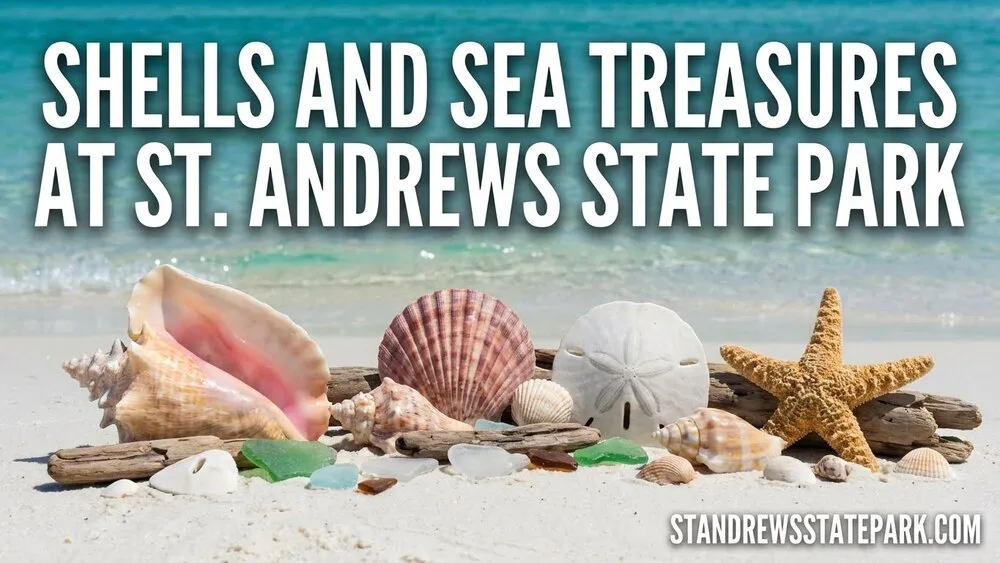
There’s a special kind of satisfaction in spotting a perfect shell half-buried in clean sand, lifting it up, and realizing it’s a small time capsule from the Gulf. At St. Andrews State Park, that feeling comes easy because the coastline here acts like a gentle sorting machine: waves, currents, and shore shape work together to deliver shells, tiny fragments, and other sea treasures right where curious eyes tend to wander.
What “Sea Treasures” Means Here: Think seashells (whole, broken, polished), sand dollars (often as small pieces), smooth sea-worn stones, and the occasional fossil fragment—all shaped by water, not manufactured.
Why This Park Produces So Many Finds
St. Andrews State Park sits at a natural meeting point where bay water and Gulf water interact, and that matters for shells. The park includes both a mainland portion and Shell Island, and the island side is boat-only. The shoreline story is big: the unit management plan describes a park footprint of 1,167 acres, with Shell Island as a 690-acre undeveloped barrier island, and estimates about 13 miles of combined shoreline plus roughly 4.6 miles of Gulf beach (with Shell Island holding about three quarters of that Gulf beach). The same plan notes that shelling is a popular beach activity here and explains that the jetty structures extend through the navigation channel and draw visitors to the adjacent waters. ✅Source
| Shore Area | What The Shore Does | What Often Washes In | Why It Matters For Shells |
|---|---|---|---|
| Gulf Beach (Mainland) | Open-wave energy, steady sorting | Mixed shell pieces, polished fragments, small bivalves | Wave action naturally “grades” shells by size and weight |
| Jetty-Influenced Waterline | Current breaks and eddies | Heavier shells, denser fragments, occasional larger finds | Flow changes can concentrate material in pockets |
| Shell Island Gulf Side | Long, undeveloped barrier-island beach face | Varied shells, cleaner breaks, subtle “wrack” deposits | Fewer obstacles can mean long, continuous deposition zones |
| Bay & Lagoon Edges | Calmer water, fine sediment settling | Small shells, tiny spirals, smoother “tumbled” bits | Lower energy favors lighter pieces and gentle polishing |
How Shells End Up On The Sand
Most seashells begin as homes for marine life, then become part of a coastal “supply chain” once they’re empty. Waves break shells, sand smooths edges, and currents move pieces like a conveyor belt. When energy drops—maybe behind a subtle sandbar or along a gentle slope—those pieces settle. That’s why you’ll often notice shell lines forming in thin bands: the beach is quietly organizing what the water delivers.
The Wrack Line
The wrack line is the beach’s natural “collection shelf.” It’s where light organic bits and shell fragments gather after wave run-up. Some days it’s a thin ribbon; other days it’s a broader band. If you’re wondering why a beach suddenly feels “shell-rich,” the answer is often as simple as: the line moved.
Sand Shapes
Even a “flat” beach has micro-landforms: shallow troughs, small berms, and gentle slopes that act like mini basins. When water drains back, heavier pieces settle first. That’s why two spots a short walk apart can feel totally different—same coast, different sand geometry, different shell mix.
Shells You Might Recognize
The Florida Panhandle’s beaches can deliver an interesting blend of bivalves (two-part shells) and spirals (single-piece shells). You won’t see the same thing every time—and that’s the point. Beachcombing here is like reading a short story where the ending changes with the sea.
- Coquina shells: small, smooth, and often found in groups; they tend to show up as neat little wedges.
- Scallop shells: fan-shaped ridges that catch light like a subtle fingerprint.
- Olive shells: glossy, streamlined spirals that look “engineered” by the sea.
- Auger shells: long and narrow, with a delicate twist that feels almost calligraphic.
- Whelk-type spirals: heavier shells with stronger curves and thicker lips, often arriving as partial finds.
- Sand Dollar pieces: thin and pale, sometimes appearing as small discs or fragments with tiny patterns.
- Fossil Bits: occasionally, small dark fragments show up that look older than the beach itself—nature’s quiet “bonus” in the sand.
How To Read A Shell Like A Naturalist
Want to make shell-finding feel less random and more like a skill? Start by noticing structure. A bivalve tells its story through the hinge line; a spiral shell reveals itself through the opening (the aperture) and the curve of the spire. When you pick up a piece and think, “What was this?” you’re already doing the right thing—asking the beach better questions.
- Edges: sharp breaks suggest a newer fragment; rounded edges suggest longer tumbling in sand.
- Weight: heavier shells often settle in different spots than paper-thin pieces.
- Texture: ridges, grooves, and ribs can point to a shell family even when the shell is incomplete.
- Color Fading: sun and salt can bleach surfaces, but pattern shadows often remain if you look closely.
A Clear Line For Florida State Parks: Live shelling is prohibited in Florida State Parks. If a shell still has a living animal inside, it belongs in the water—same place, gently returned. ✅Source
- Look for movement, a tight “door” (operculum), or a firm presence inside the shell.
- Smell is not a reliable test; visual and gentle handling are better.
- When In Doubt, leave it—beachcombing stays enjoyable when it stays respectful.
Legal And Ethical Basics For Sea Treasures In Florida
If you ever wonder where “souvenir” ends and “regulated” begins, Florida’s guidance is refreshingly specific. The Florida Fish and Wildlife Conservation Commission explains that recreational sea shell collecting depends on whether a shell contains a living organism, what species it is, and where you collect it. The same guidance notes that harvesting a shell with a living organism may require a Florida recreational saltwater fishing license, and it lists examples of prohibited harvest for certain species (including restrictions related to queen conch and some echinoderms). In plain terms: enjoy the beauty, keep your finds empty, and let the living coastline stay alive. ✅Source
Cleaning And Keeping Shell Finds
A good shell display doesn’t need fancy treatment. Most empty shells do best with simple steps: a fresh-water rinse, air drying, and gentle brushing if sand clings in grooves. If a piece is fragile, treat it like old paper—light handling, no aggressive scrubbing. The goal is to keep the natural finish intact, because that finish is the sea’s craftsmanship.
- Rinse with fresh water and let it sit briefly so trapped sand loosens.
- Dry fully before storing to keep surfaces clean and stable.
- Store in a breathable container if you’re keeping many pieces together.