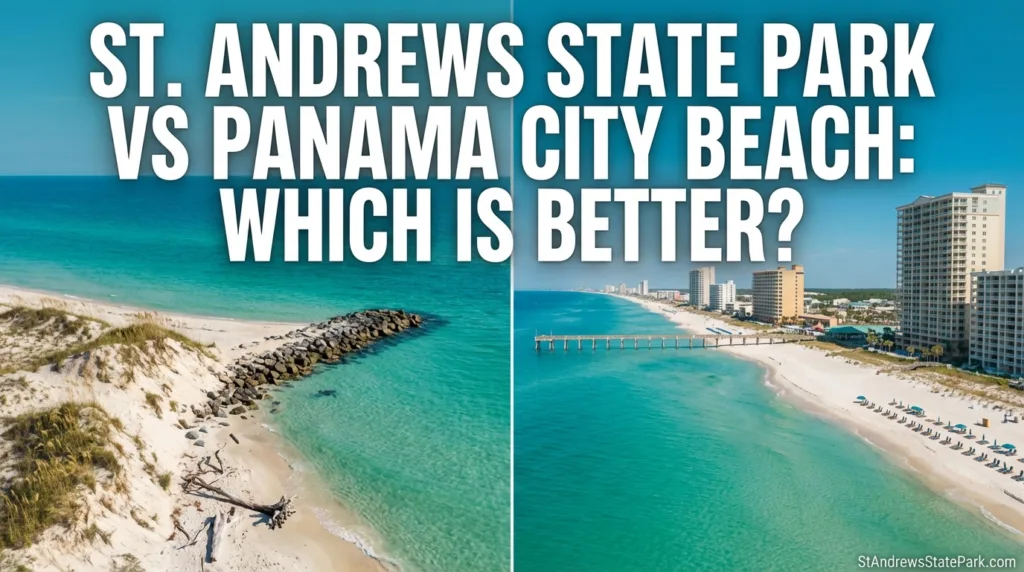
I’ve always thought this comparison gets framed the wrong way. St. Andrews State Park and Panama City Beach are not two equal stretches of sand doing the same job. One is a protected park beach with defined entry, mixed shorelines, jetties, dunes, marshes, and Shell Island access. The other is the wider PCB beach system, spread across 27 miles of shoreline and linked to 90+ public beach access points.[e] If you want the straight answer, here it is: for a nature-first beach day, St. Andrews usually comes out ahead; for range, convenience, and open-ended beach hopping, Panama City Beach gives you more room to choose.
That difference matters more than most “which is better?” articles admit. St. Andrews feels shaped by water, habitat, and park management. Panama City Beach feels shaped by access, lodging, dining, and a long run of public beachfront. Both can be excellent. They just serve different beach moods.
Most visitors split this question in one of two ways:
- Choose St. Andrews State Park if you care most about clean beach setting, snorkeling, calmer water choices, Shell Island access, camping, and a more protected coastal landscape.
- Choose Panama City Beach if you care most about free public access, longer beach walks, resort convenience, nearby restaurants, and being able to pick a different beach entry whenever you want.
How The Two Compare
| Category | St. Andrews State Park | Panama City Beach | Who It Suits Better |
|---|---|---|---|
| Beach Setting | Protected park land on a peninsula, plus park property on Shell Island that is reached by boat.[a] | Long public beachfront spread across the wider resort city area.[f] | St. Andrews for a park feel; PCB for a broader beach zone. |
| Shoreline Range | Open Gulf beach, jetty area, lagoon-side water, and access toward Shell Island.[d] | 27 miles of beach with many different access points along the coast.[e] | St. Andrews for variety in water conditions; PCB for length. |
| Entry | Open 8 a.m. to sundown; vehicle entry fee applies.[c] | Public beach access is free; parking exists at some access points, but not all.[e] | PCB for flexibility and no gate fee. |
| Nature Layer | 1,167 acres with 14 mapped natural communities in the park plan.[a] | City-managed shoreline with patrol, access management, and beach renourishment noted in the city profile.[f] | St. Andrews for habitat depth. |
| On-Site Services | Concessions, stores, shuttle ticketing, campground, and eco-tents/glamping.[d] | Dining, shopping, lodging, and entertainment are spread across the larger beach district.[e] | PCB for off-beach convenience; St. Andrews for contained amenities. |
| Overnight Stay | Campground sites include water, electric, and sewer; glamping is also available.[c] | Best paired with condos, hotels, and vacation rentals in the city beach area.[f] | St. Andrews for camping; PCB for resort-style stays. |
| Best Water Activities | Snorkeling, jetty-area swimming, fishing, paddling, and Shell Island shuttle trips.[d] | Classic open-beach swimming, long shoreline walks, general beach access, and resort-adjacent beach time.[e] | St. Andrews for activity mix. |
What Makes Them Different
People often compare these two as if they were side-by-side hotel beaches. They are not. St. Andrews is a managed state park, and the park plan treats it that way on paper as well as on the ground. The plan lists 1,167 acres, notes that the park contains 14 distinct natural communities, and describes park property on both the mainland and Shell Island.[a] Panama City Beach, by contrast, works as a much larger public beach system connected to the city’s lodging, food, parking, and access network.[f]
That is why the same sand color does not automatically create the same experience. At St. Andrews, the beach day gets filtered through park hours, a paid entrance, habitat protection, jetties, boardwalks, and a fixed recreational footprint. At Panama City Beach, the day is looser. You can move between access points, pick a different stretch of shoreline, and pair beach time with restaurants or accommodations much more easily.
One detail many articles skip: the St. Andrews plan counts about 68,800 feet of shoreline, or roughly 13 miles, once its full mix of shorelines is counted, with about 4.6 miles of Gulf beach and much of that lying on Shell Island.[a] So even though the park feels smaller on arrival, it is not a tiny sliver of beach. It is a layered coastal area.
Where St. Andrews Pulls Ahead
The biggest edge is variety inside one setting. You are not limited to one open-Gulf swim zone. The official park material points to Gulf swimming, a shallow protected pool behind the jetty, snorkeling around the rock structures, fishing areas, paddling, and the shuttle link toward Shell Island.[d] That mix is hard to match on a normal city beachfront.
I also give St. Andrews the nod for coastal character. The official plan does not describe the park as “just beach.” It maps beach dune, coastal grassland, maritime hammock, mesic flatwoods, scrub, salt marsh, coastal dune lake, and seagrass-related habitat types inside the park boundary.[a] You feel that when you move through the place. The beach is still the draw, yes, but the land behind it has texture. Real texture.
Then there is Shell Island. This is one of the strongest reasons St. Andrews often wins the comparison for visitors who care about scenery. The park’s own planning documents describe Shell Island as part of the park system and note that access is by boat, while the current park page confirms that shuttle tickets are sold through the park operation.[a] That changes the feel of the day. You are not only visiting a beach. You are visiting a beach that opens onto an undeveloped barrier-island experience.
Camping matters too. Panama City Beach does not compete with St. Andrews on this point. The state park offers campground sites with water, electric, sewer, picnic tables, and grills, and it now pairs that with eco-tent lodging for people who want something softer than a tent but still inside the park setting.[c] Sleep there, wake there, walk to the water. Easy.
Where Panama City Beach Pulls Ahead
Panama City Beach wins on range and convenience. The official tourism site says the beach area stretches for 27 miles, and the public access page says there are 90+ access points, with free public access and varying parking availability depending on the access you choose.[e] That means more flexibility, plain and simple.
If your ideal trip is built around a condo, a hotel, a meal after the beach, and the freedom to change locations without going through a park gate, Panama City Beach is easier to live with. The wider PCB area is set up for that style of travel, with beach access woven into a larger visitor district that includes dining, entertainment, and lodging across the shoreline.[f]
PCB also makes more sense for long, casual shoreline mileage. Not because St. Andrews lacks sand. It has plenty. But the city beach system spreads beachgoers across many entries and many blocks of shoreline. That broader distribution often matters more than raw beauty when the real goal is to spend hours walking, sitting near your lodging, or trying a different section of beach every day.
Water, Sand, And Beach Feel
The sand story is familiar on both sides of this comparison: white quartz sand, clear water, and that light Emerald Coast look people expect. The old park brochure even explains that St. Andrews’ quartz sand was carried south from the Appalachian system and later deposited along the barrier shoreline.[d] So the question is not really which one has “better sand.” It is which beach layout gives you the day you want.
At St. Andrews, the beach feel changes as you move. Open Gulf water is one thing. The jetty pool is another. The lagoon side has its own rhythm again. Add the Shell Island connection and the place starts to feel less like one beach and more like a compact coastal system. Panama City Beach, on the other hand, is more consistent from one access point to the next: long Gulf-facing shoreline, broad choice, easier repetition, easier routines.
Access, Fees, And How Busy It Feels
St. Andrews has a cleaner rule set. The park is open 8 a.m. to sundown, and the current entry fee is $8 per vehicle for two to eight people, with lower rates for single-occupant vehicles and walk-ins or bicyclists.[c] That paid entry shapes the visit. You commit to the park, then spend the day inside its boundaries.
Panama City Beach works differently. The public access page emphasizes that the access network guarantees free public beach entry, but it also notes that some access points have parking and many do not.[e] So PCB can feel more open and more convenient at the same time. You are not paying to enter the beach, yet you do need to think a little more about which access point fits your day.
One more thing worth noting: state park does not mean hidden. The St. Andrews plan says the park ranks among the five most visited parks in the Florida state park system.[a] So if someone tells you the park always feels empty because it is protected land, that is too simple. It is popular. Very.
The Land Behind The Sand
This is where St. Andrews starts to separate itself in a way that many comparison pieces never explain. The park plan does not just inventory beaches. It lays out habitat management. It maps 161.10 acres of beach dune, 276.46 acres of scrub, 233.65 acres of mesic flatwoods, and 68.55 acres of salt marsh, among other community types.[a] That is not filler data. It tells you what kind of place St. Andrews really is.
The same plan sets a fire-management target of 352.6 acres maintained within the optimum fire return interval, with annual burning goals between 59 and 161.3 acres.[a] In other words, the park is actively managed as living coastal habitat, not merely presented as a scenic beach backdrop. Panama City Beach, by contrast, is the wider public shoreline of a resort city, with the city profile pointing to beach patrol, shoreline stewardship, and beach renourishment as part of its coastal management work.[f]
That is the real split: Panama City Beach is the broader public beachfront of the city. St. Andrews is a beach inside a managed coastal park where the dunes, marshes, flatwoods, and shoreline access all belong to the same protected landscape.
Which One Fits Which Trip
- For families who want options in the water: St. Andrews usually has the edge because the park includes both open-Gulf and more protected water areas.[d]
- For visitors who want to stay steps from restaurants, condos, and multiple beach entries: Panama City Beach is the easier fit.[f]
- For snorkeling and jetty-focused beach time: St. Andrews stands out more clearly.
- For long, flexible shoreline use over several days: Panama City Beach makes more sense because the access network is so much larger.[e]
- For camping inside the coastal setting itself: St. Andrews wins without much debate.[c]
- For travelers who simply do not want to pay an entrance fee: Panama City Beach has the obvious edge through its public access system.[e]
Current Context
A recent Florida DEP release from 2025 noted that St. Andrews State Park ranked No. 7 on Dr. Beach’s national list, which lines up with the park’s long-standing reputation for sand quality and coastal scenery.[h] That does not automatically make it “better” for every traveler, though. Rankings tell you the beach is highly regarded. They do not tell you whether you want a park beach or a city beach.
Peak-season planning matters on the PCB side as well. The official visitor page currently notes that during High Impact Periods, an 8:00 p.m. to 5:00 a.m. curfew applies to unaccompanied minors in public areas.[g] If you are comparing these two during busy spring dates, that is useful context. So is the fact that the park’s campground and recreation areas have gone through post-Hurricane Michael restoration planning in recent years.[b]
So, which is better? For a pure beach-and-nature experience, I’d pick St. Andrews State Park first. For a longer stay built around variety, convenience, and the wider visitor infrastructure of the coast, Panama City Beach is the better match. Same region. Different beach logic.
Referenced Pages
- [a] St. Andrews State Park Approved Plan (Florida DEP PDF) – used for park acreage, shoreline totals, natural community mapping, Shell Island details, and habitat management targets. This is reliable because it is an official Florida Department of Environmental Protection planning document.
- [b] St. Andrews State Park Management Plan Amendment (Florida DEP PDF) – used for post-Hurricane Michael restoration context. This is reliable because it is an official state park planning amendment issued by Florida DEP.
- [c] St. Andrews State Park Hours And Fees – used for current opening hours, admission pricing, and campground fee details. This is reliable because it is the official Florida State Parks park-information page.
- [d] St. Andrews State Park Official Park Brochure (PDF) – used for water-area descriptions, protected jetty pool language, park activities, and park layout details. This is reliable because it is an official Florida State Parks brochure.
- [e] Panama City Beach Access Points And Map – used for 90+ public beach access points, free public access wording, parking variation, and beach flag references. This is reliable because it is the official destination site for Panama City Beach.
- [f] PCB Community Profile – used for city-scale context, shoreline management notes, and broader visitor-area framing. This is reliable because it is published by the City of Panama City Beach.
- [g] Know Before You Go In Panama City Beach – used for current High Impact Period visitor rules. This is reliable because it is the official Panama City Beach visitor-information page.
- [h] Florida DEP Release On National Beach Ranking – used for the recent Dr. Beach ranking mention. This is reliable because it is an official Florida DEP government distribution page.
FAQ
Is St. Andrews State Park actually separate from Panama City Beach?
It sits within the Panama City Beach area, but the experience is separate in practice. You enter a state park with its own rules, hours, fees, habitat protections, and recreation layout.
Which is better for snorkeling?
St. Andrews State Park is usually the better pick because of the jetties, protected water options, and its long-standing snorkeling reputation in the official park material.
Which is better for families with younger kids?
St. Andrews often works better when calmer water matters, since the park includes more than one style of swim area. Panama City Beach can still work very well, but it is less of a contained park setting.
Is St. Andrews worth paying for if Panama City Beach has free public access?
Usually yes, if you want a park beach with varied water access, jetties, camping, trails, and the Shell Island connection. If you only want open sand and easy public entry, PCB may be the smarter value.
Which one feels less built-up?
St. Andrews State Park. The state park setting places the beach inside a protected coastal landscape rather than inside the wider lodging and dining strip of the city beach area.
Can you reach Shell Island more easily from St. Andrews?
Yes. Official park information ties shuttle access and ticketing directly to the St. Andrews operation, which makes the park the more natural launch point for a Shell Island-focused day.