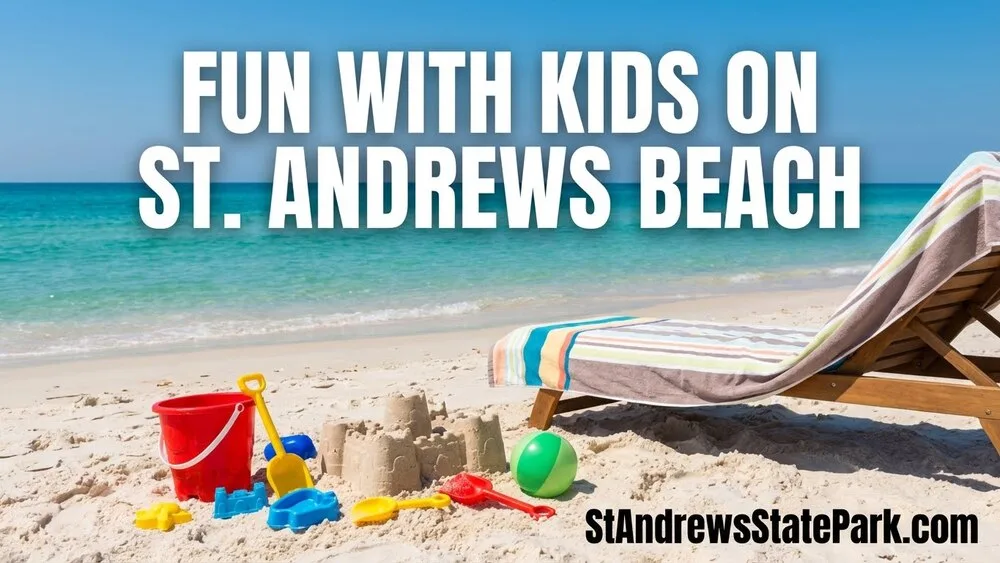
St. Andrews Beach is built for family fun in the simplest way: soft sand, clear water, and space for kids to be kids. When I’m here with families, I see the same thing every time—children don’t need complicated plans. Give them a safe shoreline, a few small challenges, and a little imagination, and the beach turns into a playground that practically runs itself.
🧭 How This Article Works
Below are five simple, kid-approved activities that fit the real rhythm of St. Andrews Beach. Each one stays close to what families can do right on the sand (or just beside it), with minimal gear and a maximum smile.
Five Activities Families Actually Do Here
🐚 Shell And Color Hunt
Beachcombing that feels like treasure hunting.
🐟 jetty “Mini Safari”
Peek into shallow water and spot fast little swimmers.
🏰 Sandcastle Engineering
Build a “tiny city” with simple tools and big teamwork.
🖍️ Lagoon Sketch And Spot
A calm break with nature notes kids love to show off.
🏝️ Shell Island Big-Space Play
More beach, fewer distractions, pure family time.
🗂️ Gear That Covers Most Activities
Bucket, small shovel, mesh bag, paper, pencil, and (optional) kid mask.
| Activity | Where It Works Best | What You Need | Best For Ages | Typical Time |
|---|---|---|---|---|
| Shell And Color Hunt | Open Gulf beach where shells wash in | Mesh bag, small notebook | 3+ | 20–40 min |
| Jetty “Mini Safari” | Shallow jetty-side water (look, don’t climb) | Mask, water shoes | 5+ | 15–30 min |
| Sandcastle Engineering | Firm, damp sand near the waterline | Bucket, shovel, cups | 2+ | 30–60 min |
| Lagoon Sketch And Spot | Lagoon-side picnic areas | Paper, pencil, clip board | 4+ | 20–45 min |
| Shell Island Big-Space Play | Shell Island shoreline (boat access) | Water, snacks, shade plan | All ages | 2–4 hours |
Why St. Andrews Beach Feels So Family Friendly
Families don’t just come here for a pretty shoreline. The park sits where St. Andrew Bay meets the Gulf of Mexico, which means you can match the activity to the mood—open beach energy on one side, protected water and lagoon views on the other. That mix is the secret sauce: kids burn off steam, then reset, then do it again.
📌 Numbers That Help You Picture The Place
- The park covers 1,167 acres, with land on the mainland and on Shell Island.
- Shorelines total about 68,800 feet (around 13 miles), including roughly 4.6 miles of Gulf beach.
- Shell Island is about 690 acres and includes over four miles of pristine beaches.
- The two jetty structures are managed by the U.S. Army Corps of Engineers and draw visitors for fishing and diving.
- The Gulf pier extends more than 400 feet over the Gulf.
Another practical detail: the park is open 8 a.m. to sundown every day, and day-use admission is typically $8 per vehicle (two to eight people), with other options for single-occupant vehicles and walk-ins. If your day hinges on timing, that simple schedule keeps the plan clean and predictable.✅Source
Five Simple Activities for Families
Activity 1: Shell And Color Hunt on the Shore
This is the easiest “game” on St. Andrews Beach, and it teaches kids how to notice what’s around them. Instead of “find the biggest shell,” make it about patterns and colors. Kids stay focused longer, and the beach stays what it should be—a natural place, not a contest.
- Set a simple color list: white, tan, gray, and one “wild card” color kids choose.
- Look for textures: smooth, ridged, speckled, and “tiny like confetti.”
- Use a mesh bag so sand drains out and you can see your “collection” grow.
If you want to keep it tidy, try a one-minute museum: lay finds on the sand, let each child pick a “favorite,” and ask one question—why that one? It’s a small moment, but it sticks like a good story.
Activity 2: Jetty Mini Safari With a Mask and Curious Eyes
Near the rock jetty, the water can reveal a whole second world. Think of it like a glass window into the Gulf—except the “exhibit” moves. With a kid-sized mask and slow steps, children can spot small fish, shifting shadows, and the way rocks become a home base for marine life. The state parks program highlights the jetty as an artificial reef habitat where snorkelers may see species such as rays, angelfish, redfish, sheepshead, and even octopus on a lucky day.snorkeling-st-andrews-state-park" target="_blank" rel="nofollow noopener">✅Source
🧩 What Makes This Work for Kids
The “safari” stays simple: look, name, count. Ask: “How many different shapes did you see in two minutes?” It turns quick observations into a mini mission without turning the beach into homework.
- Mask-only version: face in the water, hands by your sides, slow breathing.
- Shadow-count version: count “moving shadows” and guess which are fish.
- Rock-story version: pick one rock, watch it for 60 seconds, describe what passes by.
Activity 3: Sandcastle Engineering With Roles for Everyone
Sandcastles last longer when the build feels like a team project, not a parent doing the “hard part.” Give kids roles—suddenly the beach becomes a little construction site where everyone matters. The best sand for this is damp and packable, the kind that holds a wall without collapsing the second someone cheers.
- Engineer (older kid): plans the “city map” in the sand.
- Builder (any age): packs buckets and flips towers.
- Water Runner: brings just enough water to strengthen walls.
- Detail Artist: draws doors, windows, and “roads” with a shell.
Want a fun twist that doesn’t add chaos? Ask one question: “Can you build a bridge that survives three waves?” It’s a tiny challenge, but it turns a basic castle into an experiment kids remember.
Activity 4: Lagoon Sketch And Spot
Kids don’t always need more motion—they often need a calm reset. The lagoon side gives you that quieter feel, perfect for a short “sketch and spot” session. Bring paper, a pencil, and a simple idea: draw three things you can see, then label them with your own words. The goal isn’t art. It’s attention.
- Shape hunt: draw one circle, one triangle, and one wavy line you notice in nature.
- Sound note: write one word for a sound you hear (wind, waves, birds).
- “One small detail”: a tiny shell pattern, a footprint trail, or a ripple line.
🧠 Why This Is More Than “Downtime”
When kids pause to observe and describe, they build a mental map of the beach—where sand changes texture, where water calms, where shade feels better. That “map” makes the rest of the day smoother for everyone.
Activity 5: Shell Island Big-Space Play
If your family wants the “wide-open beach” feeling, Shell Island can deliver it in a way that feels almost like stepping off the main stage and into the backdrop. It’s part of the same park system and is boat-access only, so the trip itself becomes part of the adventure—kids love the moment the shoreline starts to look endless. The park’s concessionaire supports shuttle trips, boat rentals, and other visitor services tied to Shell Island access.✅Source
- Space game: choose a “base camp” spot, then run three short missions—shell hunt, sand build, shoreline walk.
- Footprint story: kids follow their own trail back to camp and narrate the “journey.”
- Quiet minute: sit, listen, and pick one “sound of Shell Island.”
One question makes this feel special without adding effort: “What’s different here compared to the main beach?” Kids usually answer with something honest and sharp—more shells, more space, different waves, or simply “it feels like an island.” That’s the kind of memory families come back for.
A Few Park Rules Families Ask About
Some questions come up again and again, especially for first-timers. If your family is traveling with a dog, Florida State Parks notes that pets are not permitted on beaches, boardwalks, playgrounds, or in bathing areas, and each park may have specific restrictions in place. It’s always smart to align your day so kids can enjoy the beach zones freely while pet time happens in the designated areas.✅Source
FAQ
Which activity works best for toddlers?
Sandcastle engineering is usually the easiest win for toddlers, especially when you keep tools simple (bucket and small shovel). Add a “decorator” role—placing shells on walls—and toddlers stay engaged without needing deep water time.
Do we need special gear for the jetty mini safari?
You can do it with no gear by watching the shallows, but a kid-sized mask makes it more exciting. Keep the focus on looking, not “going far,” and the activity stays easy and family-friendly.
Is Shell Island a full-day commitment?
Not necessarily. Many families treat it as a half-day experience: a few hours of big-space play, then back for snacks, shade, and a slower afternoon on the mainland side. The key is bringing enough water and a clear “base camp” plan.
How do we keep the shell hunt from turning into chaos?
Use categories instead of “more.” Colors, textures, or sizes keep the game structured. Then do a quick “one favorite shell” share-out—kids feel heard, and you move on without a meltdown.
What if my kids get bored fast?
Rotate between a movement activity (sandcastle building or shoreline walk) and a quiet activity (lagoon sketch and spot). Think of it like switching songs in a playlist—same day, different rhythm, happier kids.
Can we bring a dog and still do these activities?
Yes, with planning. Many families separate the day into two parts: dog time in allowed zones, and beach activities in the pet-restricted areas so kids can fully enjoy the shoreline without mixed expectations.