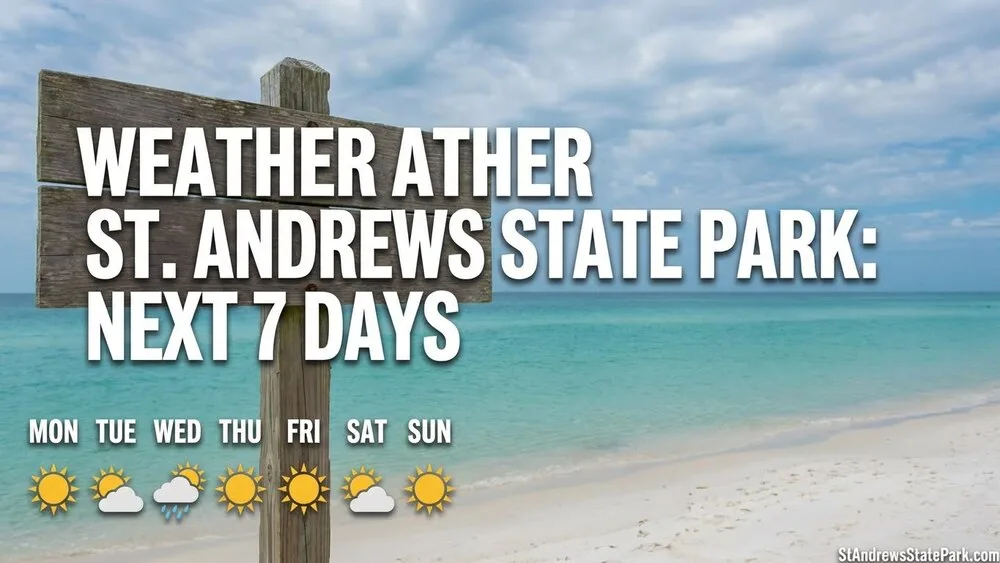
Weather at St. Andrews State Park can look simple on a 7-day forecast, then feel totally different once you step onto sand. Why? This park sits where open Gulf air meets protected lagoon water, and that contrast makes wind, humidity, and cloud timing matter as much as the temperature number itself. Use the outlook above as your base, then read the details below to understand what those daily icons and wind arrows usually mean inside the park.
🌬️ Wind Is The Hidden Driver
If you track only temperature, you’ll miss the big shift: wind speed and wind direction often decide whether the beach feels smooth or busy. Even a “nice” day can feel sharp when breeze rises along open shoreline.
- Direction tells you which side feels more exposed.
- Gusts explain those sudden sandy bursts.
- Afternoon often runs windier than morning.
☀️ Heat Feels Different Near Water
Along the coast, humidity can turn a moderate reading into a sticky one. Watch the “feels like” number, but also pay attention to shade and breeze. A moving air flow can make midday feel lighter than expected.
- High humidity = slower cooling on skin.
- Cloud cover can soften peak sun.
- Sea air can swing comfort fast.
🌦️ Rain Icons Need Context
A single rain icon doesn’t always mean all-day rain. In warm months, showers can be brief and localized. Look at timing, storm chance, and wind shift. Is it a quick pass or a steady pattern?
- Timing matters more than totals.
- Thunder changes plans quickly.
- Cloud build often peaks later.
📍 How The Park Shapes Weather
St. Andrews State Park is a place where microclimates feel real. The park has long, varied shoreline—about 68,800 feet (roughly 13 miles) across Grand Lagoon, St. Andrew Bay, and the Gulf of Mexico, with roughly 4.6 miles of Gulf beach. Shell Island holds about three quarters of that Gulf beach length. ✅Source
That geography creates a simple rule: when the forecast shows wind, ask “Which side?” The Gulf-facing stretches take the full push of open-water air, while lagoon edges often feel more sheltered. Even within the same hour, you can have two moods—a brisk beach and a calmer waterfront nearby.
🧭 A Common Daily Rhythm
Many coastal days here run like a two-act play: a quieter morning, then a more energetic afternoon breeze. Is it guaranteed? No. Still, it’s a useful lens when you compare the early forecast line to the late-day line.
- Morning: lighter wind, gentler air feel.
- Midday: sun strengthens, mixing increases.
- Afternoon: sea breeze can lift gusts along open sand.
🌬️ Wind And Surf Signals
At St. Andrews State Park, wind is not just “air movement.” It shapes surface texture, water clarity, and how comfortable the shoreline feels. Think of the Gulf like a wide-open stage: onshore wind (blowing from the water toward land) can add more chop, while offshore wind (blowing from land toward water) can make the beach feel cooler and sometimes smoother right at the edge.
| Forecast Detail | What You Often Notice | Why It Matters In The Park |
|---|---|---|
| Wind direction changes | One side feels calmer, the other more exposed | Lagoon-facing areas can stay gentler when the Gulf side is active |
| Wind speed rises | More spray, more sand movement | Open beaches feel it first; dunes can reduce gusts behind them |
| Gusty periods | Short bursts that feel stronger than the average | Useful for planning comfortable breaks and timing |
| Swell/surf notes | Water shifts from glassy to textured | Helps set expectations for snorkeling and shoreline play |
🪨 Near Jetties: Current Awareness Helps
If your plan includes the jetties, it’s smart to check the local surf zone forecast and the rip current outlook before entering the water. Rip currents can form near structures like jetties even on beautiful days. ✅Source
🏖️ Dunes And Windbreak Effects
The park’s dunes are not just scenery; they act like a natural wall against wind. The unit plan notes that established beach dunes can build to well over 25 feet during long periods between major storm events, and those elevations can change over time as the coast reshapes. ✅Source
Here’s the practical piece: if the forecast shows steady wind, areas just behind dunes may feel noticeably more comfortable than fully exposed sand. It’s like stepping from the front of a fan to the side of it—same day, different experience, and your 7-day outlook starts making more sense.