
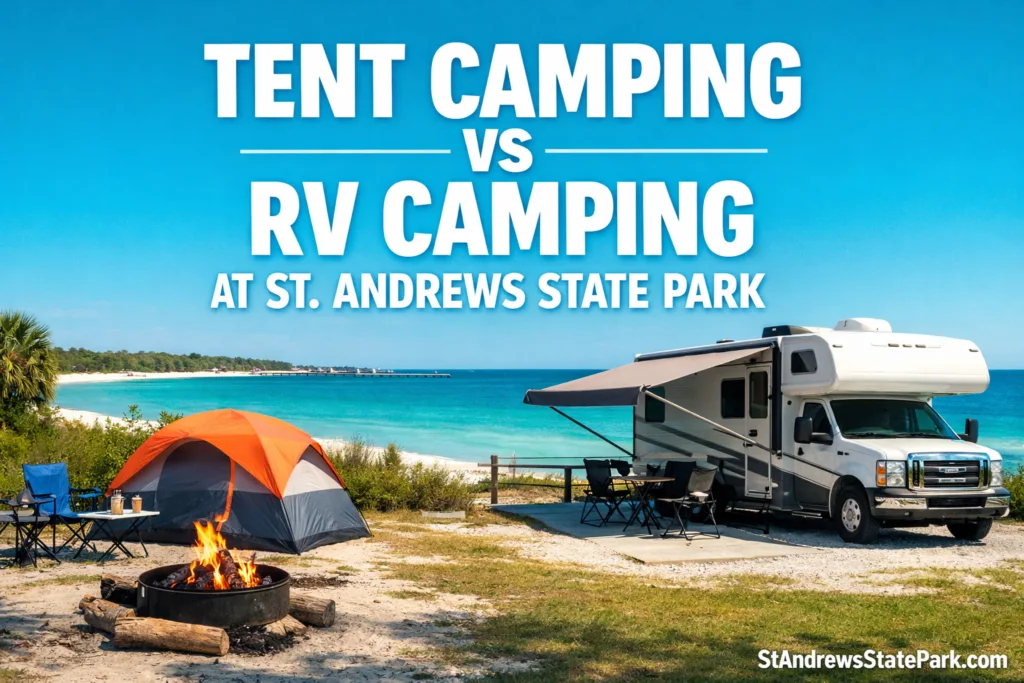
At St. Andrews State Park, the usual tent vs. RV debate feels a little different. This is not a generic inland campground where every site blurs together. You are camping inside a coastal park with Gulf-side shoreline, Grand Lagoon access, bright sand, salt air, and a campground that sits close enough to the water for weather, wind, drainage, and comfort to shape the whole experience. The park’s setting is one reason it draws so much attention: Florida State Parks describes it as a large beach park with over 1.5 miles of shoreline along the coast and Grand Lagoon.[b]
🏕️ Tent camping here feels more immersive, more open to the air, and often more rewarding in the cooler months. 🚐 RV camping feels more resilient when heat, humidity, rain, salty gear, and longer stays start piling up. At this park, the smarter choice is usually not about camping philosophy. It is about season, site position, and how much comfort you want after a full day around the water.
The current fee structure already nudges the comparison in a clear direction. Using the official park fee page, a one-night stay starts at $34.70 before tax for a tent reservation and $41.70 before tax for an RV reservation. That difference comes from the park’s $28 nightly campsite rate, the $6.70 nonrefundable reservation fee, and the $7 nightly utility fee that applies to RV stays but not to tent camping.[a]
| What Changes At This Park | Tent Camping | RV Camping |
|---|---|---|
| Cost Pressure | Lower starting cost and no nightly utility add-on. | Higher nightly total, but more comfort per dollar in hot or wet weather. |
| Shared Infrastructure | Benefits from a developed campground rather than a rough primitive field. | Takes fuller advantage of hookups, storage, climate control, and easier cleanup. |
| Seasonal Comfort | Excellent in mild months when sea air feels refreshing instead of sticky. | Stronger in late spring and summer when heat, rain, and humidity rise. |
| Beach-Day Recovery | Simple and scenic, but wet towels, sand, and overnight moisture build up faster. | Easier for drying gear, storing food, cooling down, and handling longer stays. |
| Site Sensitivity | More sensitive to surface firmness, drainage, and recent rain. | Still site-dependent, but less exposed to the day-to-day discomfort of damp ground. |
| Overall Feel | Closer to the sound, breeze, and texture of the park. | Closer to a stable basecamp for a beach-and-lagoon stay. |
Why This Campground Feels Different
A lot of camping articles flatten St. Andrews into a beach label and stop there. That misses the real shape of the place. The state’s approved management plan says the park covers 1,167 acres, protects 14 natural communities, and has a standard campground along Grand Lagoon with the Lagoon and Pine Grove loops, 176 sites, and 4 bathhouses. The same plan also describes St. Andrews as consistently among the five most-visited parks in the Florida State Park system. That combination matters because you are not choosing between “simple” camping and “comfortable” camping in a vacuum. You are choosing how you want to handle a busy, highly developed coastal park that still feels very tied to wind, water, and shoreline conditions.[c]
🌊 The overlooked detail is this: St. Andrews is a shared-infrastructure campground. The official campground description says each campsite includes water, electric, and sewer connections, plus a picnic table and grill. That means tent campers are not stepping into a stripped-down backcountry setup. They are choosing to tent camp inside a campground that is already engineered strongly enough to support RV use.[d]
Where Tent Camping Pulls Ahead
When the air is comfortable, tent camping at St. Andrews State Park can feel exactly right. You hear more of the park. You notice the shift in evening breeze. You step outside and the campground still feels connected to the shoreline instead of sealed off from it. In the cooler part of the year, that extra exposure feels less like sacrifice and more like the whole point. It is the difference between watching the coast through a window and actually sleeping inside its rhythm.
The climate data backs that up. NOAA’s 1991-2020 normals for nearby Panama City show average highs and lows of 72.9°F / 51.5°F in March and 78.7°F / 57.8°F in April, which is a sweet spot for breathable, comfortable tent camping. The same report shows how sharply the trade-off changes in summer: July averages 91.1°F / 75.0°F, August averages 90.9°F / 74.7°F, and both months sit above 7.4 inches of average rainfall. When the park is warm, wet, and humid, the margin between “refreshing beach trip” and “sticky overnight camp” gets much thinner for tent users.[e]
- Tent camping makes the most sense here when you value openness, lower cost, and a stronger sensory connection to the park.
- It also fits shorter stays well, especially when most of the day will be spent on the beach, trails, piers, or around the lagoon.
- The developed campground infrastructure softens some of the inconvenience, so tent camping at St. Andrews still feels civilized rather than rough-edged.
Where RV Camping Takes The Lead
Once the forecast turns hot, damp, or unstable, RV camping starts looking less like a luxury and more like the practical format for this park. St. Andrews is the sort of place where you may come back from the water with sandy feet, damp clothing, salty gear, half-dried towels, and another humid evening still ahead. In that setting, hard walls, controlled temperature, enclosed storage, and a dry place to reset can matter more than the nightly fee gap.
The park’s own planning history helps explain why RV camping feels unusually solid here. The approved plan records campground upgrades that included higher-voltage, more reliable electrical service, new wiring in five electrical loops, bathhouse work, a remodeled dump station, and improvements to the campfire circle and amphitheater. That same plan also notes that several campsites and road segments in both campground loops are vulnerable to frequent flooding and shoreline erosion. For RV campers, that does not erase site selection, but it usually reduces the discomfort penalty. For tent campers, ground condition can shape the whole night.[c]
🚿 Another park-specific edge for RV users is the rhythm of multi-day beach living. After two or three days, the convenience of climate control, interior storage, and quicker drying starts compounding. At a coastal park, comfort stacks up quietly. One humid night is manageable in a tent. Four or five can feel like carrying wet laundry on your back.
The Site Factors That Matter More Than Camper Type
The biggest mistake people make with this topic is acting as if the answer lives only in the words tent or RV. At St. Andrews, site position can outweigh the camping format itself. Lagoon-adjacent exposure, tree cover, drainage after rain, distance to bathhouses, and how much breeze a site catches all matter. A well-chosen tent site in a mild weather window can beat a mediocre RV site. A well-positioned RV in a hot stretch can make the whole trip easier. This is one of those parks where the map matters almost as much as the gear.
- Loop context matters. The campground is not a blank rectangle. The Lagoon and Pine Grove loops behave differently because the campground follows the shoreline rather than sitting far inland.
- Bathhouse access matters. With four bathhouses across a 176-site campground, proximity matters more to tent campers who use shared facilities more often.
- Surface conditions matter. In a coastal campground, small changes in elevation and drainage can make one site feel stable and another feel fussy after rain.
- Length of stay matters. One or two nights favors simplicity. A longer stay favors storage, cooling, and recovery space.
Recent Changes That Affect The Choice
Reservation timing now plays directly into the comparison. Florida State Parks says Florida residents may reserve campsites up to 11 months in advance, and that matters because the most appealing dates at a park like St. Andrews do not linger. If you want the weather window where tent camping feels strongest or the long-weekend periods where RV comfort is easiest to justify, you are not just choosing a camping style. You are competing for timing.[f]
There is also a newer middle lane in the park. Florida State Parks highlights three eco-tents facing Grand Lagoon at St. Andrews, which shifts the conversation a little. For some travelers, that option answers the core question without forcing a pure tent-or-RV decision. It keeps some of the water-facing, outdoor feel while moving away from the extra exposure of standard tent camping.[g]
🏕️ Tent Camping Usually Fits Better If
- You are targeting cooler months or mild shoulder-season weather.
- You want lower cost without stepping down to a primitive campground.
- You care more about sound, breeze, and openness than sealed-in comfort.
- Your stay is short enough that gear drying, storage, and indoor recovery space are less important.
🚐 RV Camping Usually Fits Better If
- You are camping in late spring or summer, when heat and rainfall rise.
- You want easier beach-day recovery after salt, sand, and humidity build up.
- You are staying longer and want stable storage, cooling, and a more forgiving setup.
- You prefer a campground experience that works more like a coastal basecamp than an exposed overnight camp.
Frequently Asked Questions
Are tent campers pushed into primitive sites at St. Andrews State Park?
No. Standard campground sites are developed and shared across the campground format, which is why tent camping here feels more serviced than many beach campgrounds.
Does RV camping have a clear advantage year-round?
Not year-round. In mild months, tent camping can feel more connected to the park and comes at a lower starting cost. In hotter and wetter periods, RV camping usually becomes the easier fit.
Why does this comparison feel more site-dependent than usual?
Because the campground follows a coastal setting on Grand Lagoon. Drainage, breeze, bathhouse distance, and shoreline exposure can change the experience almost as much as your camping style.
Is the fee gap between tent and RV camping large?
The gap is real but not enormous. The key difference is the nightly utility fee applied to RV reservations, while tent camping avoids that extra charge.
What if I like the idea of a tent stay but want more comfort?
The park’s eco-tents are the natural middle ground. They soften the exposure of standard tent camping while keeping more of the outdoor, lagoon-facing mood than a typical RV stay.
How far ahead should I think about reservations?
Earlier than many people expect. The reservation window is long enough that the best weather periods and the most appealing site choices can disappear well before the trip month arrives.
Source Notes
[a] Hours & Fees | Florida State Parks – Used for the current campsite rate, reservation fee, RV utility fee, and park hours. (Reliable because it is the official Florida State Parks page for this park.)
[b] St. Andrews State Park | Florida State Parks – Used for the park’s shoreline-oriented setting and official park overview. (Reliable because it is the official statewide park profile maintained by Florida State Parks.)
[c] St. Andrews State Park Approved Plan (2016) | Florida Department of Environmental Protection – Used for acreage, campground loops, site count, bathhouse count, park visitation context, natural communities, infrastructure upgrades, and campground condition notes. (Reliable because it is an official DEP planning document for the park.)
[d] Campground Open At St. Andrews | Florida State Parks – Used for campsite utility details, picnic tables, and grills. (Reliable because it is an official Florida State Parks information page focused on the campground.)
[e] Summary Of Monthly Normals, Panama City 5N, FL (1991-2020) | NOAA NCEI – Used for average temperature and precipitation figures that affect seasonal camping comfort. (Reliable because it is NOAA climate normals data from the National Centers for Environmental Information.)
[f] Reservation Information | Florida State Parks – Used for the statewide reservation window that affects campsite availability at St. Andrews. (Reliable because it is the official Florida State Parks reservation policy page.)
[g] Glamping With A Water View | Florida State Parks – Used for the current eco-tent offering at St. Andrews State Park. (Reliable because it is the official Florida State Parks page for the park’s glamping product.)