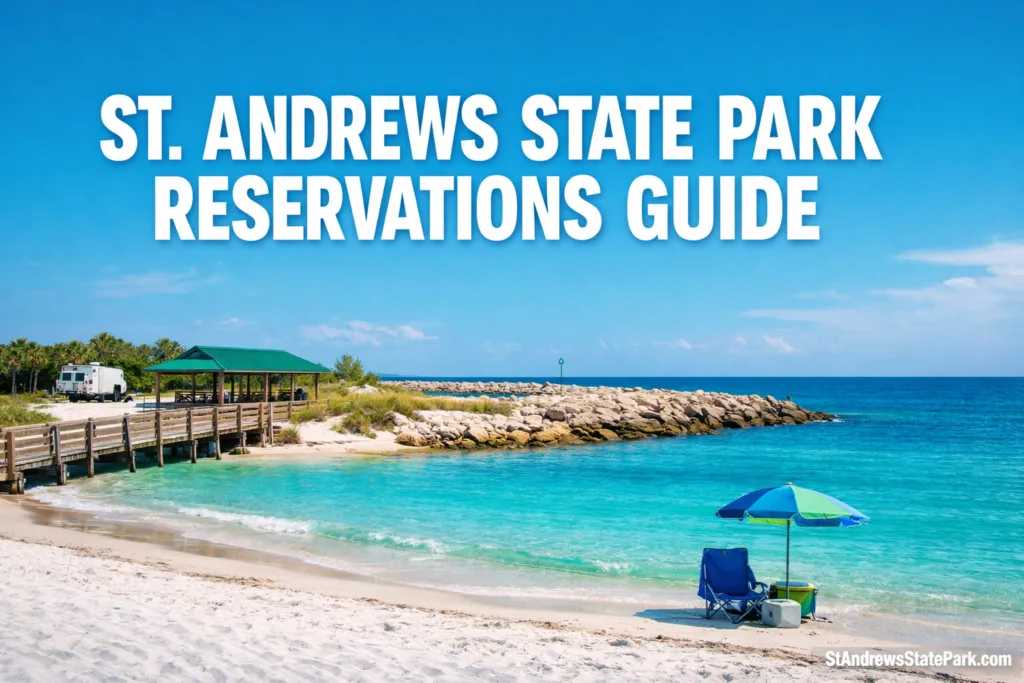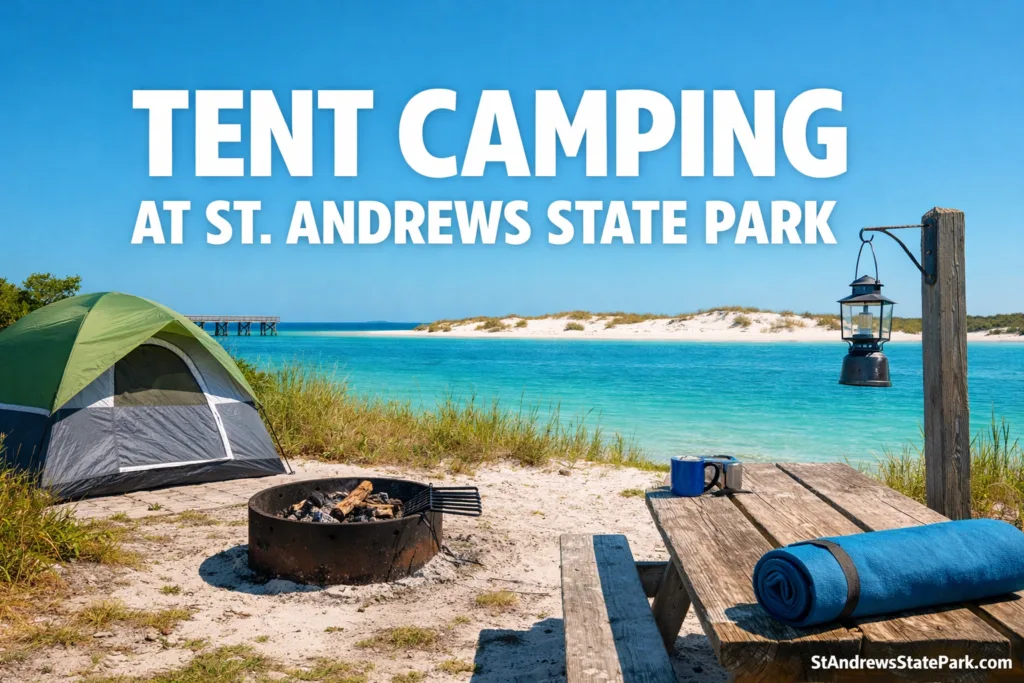
Tent camping at St. Andrews State Park feels different from the usual beach-area overnight stay. You are not pitching a tent beside a generic access road and hoping the shoreline is worth the drive. You are staying inside a large coastal state park where Grand Lagoon, the Gulf-facing beach, trails, jetties, bird habitat, and day-use water access all sit inside the same landscape. That is why this campground has real weight. It is structured, scenic, and deeply tied to the park itself, not just to the idea of sleeping outdoors.
⛺ One detail that matters right away: this is developed tent camping, not isolated backcountry camping. That means the appeal is not raw remoteness. The appeal is easy access, waterfront atmosphere, bathhouse comfort, and the rare feeling that your campsite belongs to a much bigger coastal system.
The Campground In Real Numbers
| Item | What The Verified Detail Says | Why It Matters For Tent Campers |
|---|---|---|
| Main Campground Layout | Two campground loops sit in the pinewoods near Grand Lagoon, with 176 sites overall and a separate youth-group tent area.[a] | This is a large, organized campground, not a tiny overflow camp hidden behind the beach. |
| Gate Hours And Day Access | The park lists hours as 8 a.m. to sundown, 365 days a year, with $8 per vehicle day-use admission.[e] | Your campsite sits inside a park built for full-day movement, not only nighttime use. |
| Tent-Camping Cost Note | The state fee schedule lists camping at $28 nightly, and states that the utility fee does not apply to tent camping.[d] | This is one of the most useful money details people often miss. |
| Current Overnight Mix | Current amenities information says sites accommodate tents through RVs up to 50 feet, and the park now also offers eco-tents facing Grand Lagoon.[f] | Tent camping remains central here, but it sits inside a broader, more flexible overnight setup. |
| Park-Wide Setting | The current park page highlights five distinct ecological landscapes, active campground reservations, and a shuttle to Shell Island.[h] | Your tent stay is connected to a much larger shoreline experience. |
What Tent Camping Here Actually Means
A lot of pages talk about St. Andrews State Park as if the overnight piece is just another campground near the coast. It is more specific than that. The tent-camping experience here is built around a full-service campground format: numbered sites, bathhouse access, internal roads, picnic infrastructure, and close reach to major day-use zones. That makes it friendlier for first-time tent campers, families, and anyone who wants coastal scenery without giving up campground basics.
That distinction matters because many coastal parks look dramatic online but feel thin once you strip away the beach photos. St. Andrews holds up better. The campground has enough scale to feel substantial, enough surrounding parkland to feel immersive, and enough built support to feel practical. In plain terms, it is a place where tent camping still feels easy even though the setting looks almost like a postcard.
Why The Setting Feels Bigger Than A Standard Beach Campground
The park’s approved management plan is what gives this campground its real scale. It places St. Andrews State Park at 1,167 acres, identifies 14 distinct natural communities, records 1,011,837 visitors in FY 2014/2015, and estimates a daily recreational carrying capacity of 6,860 users. Those numbers do not just make the park sound busy. They explain why tent camping here feels layered. You are staying inside a place large enough to function as a major recreation landscape, not a small beachside campground with a few spare sites tucked into the trees.[c]
🌊 Water Shapes The Stay
Grand Lagoon, the inlet, the jetties, and the Gulf-facing beach all influence how the campground feels from morning to night.
🌿 Habitats Stay Visible
Boardwalks, marsh views, flatwoods, scrub, and shoreline vegetation keep nature in the foreground instead of turning camping into pure parking-lot convenience.
🧭 The Campsite Is Not The Whole Story
At this park, the overnight base works because it connects directly to beaches, water access, ranger areas, and shoreline recreation.
Where Campground Comfort And Coastal Management Meet
This is also where the park becomes more interesting than the average campground review. The official campground reopening notice and current camping updates show a place that has been repaired, reopened, and actively improved rather than simply left to age in place. Reopened campground sites are described there as having water, electric, and sewer connections. For tent campers, that detail says a lot. Even when you arrive with a minimal setup, you are staying in a campground with serious utility infrastructure and a clear investment in long-term usability.[b]
📘 Another detail many articles skip: the management plan does not treat the campground as a separate tourist bubble. It specifically ties the camping loops to shoreline erosion, tidal flooding exposure, vegetative buffering, living-shoreline planning, electrical reliability upgrades, and raised campsite grades. That is a strong sign that tent camping here exists inside real coastal management, not outside of it.
Why does that matter on the ground? Because a campground built beside Grand Lagoon is always in conversation with water, wind, and shoreline movement. At St. Andrews, that conversation is visible in the planning record. You can feel it in the layout, in the relationship between campsites and lagoon edge, and in the park’s steady push to keep comfort and coastal durability moving together.
Water Access Is Part Of The Overnight Experience
The best way to understand tent camping at St. Andrews State Park is to stop treating the campsite as the headline and start treating water access as the headline. The current park page frames the location through five ecological landscapes and direct access to the Shell Island shuttle. That is exactly right. The campground works because it plugs into a full coastal day: lagoon views, shoreline walking, boat activity, beach time, and the sense that one overnight reservation opens the door to an entire park network.[h]
That network includes the jetties too. The park’s official snorkeling page describes the rock jetty at St. Andrews as one of the best snorkeling spots in West Florida. That is not a small side note. It helps explain why this campground attracts more than classic tent campers. You share the park with swimmers, snorkelers, paddlers, anglers, and wildlife-watchers, and that mix gives the campground a livelier, more complete identity than a normal inland overnight stop.[g]
Why This Campground Stays Memorable
Some campgrounds are memorable because they are remote. Others are memorable because they are easy. St. Andrews State Park lands in the sweet spot between those two. It gives tent campers real infrastructure, real scenery, and a landscape that still feels biologically rich. You get pinewoods around the loops, lagoon character near camp, and fast access to the larger beach-and-water system that made the park famous in the first place.
That is why the campground holds its value even in a state filled with beach destinations. A hotel room can put you near the coast. Tent camping here puts you inside the park. That difference may sound small on paper. In practice, it changes everything: the pace, the atmosphere, the evening light on the lagoon, the early-morning quiet before day visitors build in, and the feeling that your overnight stay belongs to a place with genuine ecological weight.
Official References
- [a] St. Andrews State Park Official Park Guide (PDF) — Used for the campground’s physical layout, total site count, and youth-group tent area. This is reliable because it is an official Florida State Parks park guide.
- [b] Campground Open at St. Andrews — Used for current reopening and renovation context, plus the utility details on reopened campsites. This is reliable because it is a current Florida State Parks update page.
- [c] St. Andrews State Park Approved Plan 2016 (PDF) — Used for acreage, natural-community count, historic visitation, economic impact, carrying capacity, and campground resilience planning. This is reliable because it is an official Florida Department of Environmental Protection management document.
- [d] Florida State Parks Fee Schedule (PDF) — Used for the listed camping fee and the note that the utility fee does not apply to tent camping. This is reliable because it is the official statewide fee schedule published by Florida State Parks.
- [e] St. Andrews State Park Hours And Fees — Used for daily operating hours and vehicle admission. This is reliable because it is the park’s official hours-and-fees page.
- [f] St. Andrews State Park Experiences And Amenities — Used for current campsite accommodation range and eco-tent details. This is reliable because it is the park’s official amenities page.
- [g] Snorkeling At St. Andrews State Park — Used for the official description of the jetty snorkeling area. This is reliable because it is an official Florida State Parks feature page focused on the park.
- [h] St. Andrews State Park Main Park Page — Used for current reservation status language, ecological-landscape framing, and Shell Island shuttle access. This is reliable because it is the park’s main official Florida State Parks page.
Common Questions
Is Tent Camping Allowed At St. Andrews State Park?
Yes. Tent camping is part of the park’s main campground offering, and current park information also shows that camping is still an active overnight use at St. Andrews State Park.
Is The Campground Primitive Or Full-Facility?
The main campground is a developed campground, not a primitive backcountry camp. That means organized loops, bathhouse access, site infrastructure, and strong integration with the park’s main recreation areas.
Do Tent Campers Pay The Utility Fee?
The official state fee schedule specifically notes that the utility fee does not apply to tent camping. That makes the pricing structure more favorable for tent campers than many readers expect.
How Big Is The Campground?
The official park guide describes two campground loops near Grand Lagoon and lists 176 sites overall, which makes this one of the more substantial campground footprints in the area.
What Makes Tent Camping Here Stand Out?
It is the combination of developed camping comfort and high-value coastal access. You are camping inside a large state park with lagoon frontage, jetties, beach use, trails, habitat diversity, and Shell Island access in the same overall setting.
Is Tent Camping Here Mostly About The Campsite Itself?
Not really. The campsite matters, but the bigger value comes from how the campground connects to the rest of St. Andrews State Park. This is one of those places where the surrounding shoreline and water access shape the stay as much as the tent site does.